
HY-3D 40150 × 25

- Max. load, two hinges40 kg
- Min. leaf thickness35 mm
- Max. leaf width850 mm
- Hinge body thickness21.55 mm
- Mortise L × W × D150 × 25 × 22.5 mm
Home / Products / 3D Adjustable Concealed Hinge
Completely hidden when the door is closed, and adjustable on three axes after the door is hung. Four load ratings for interior, solid timber and heavy-duty doors — zinc alloy body, 180° opening, salt spray tested 48–72 hours.
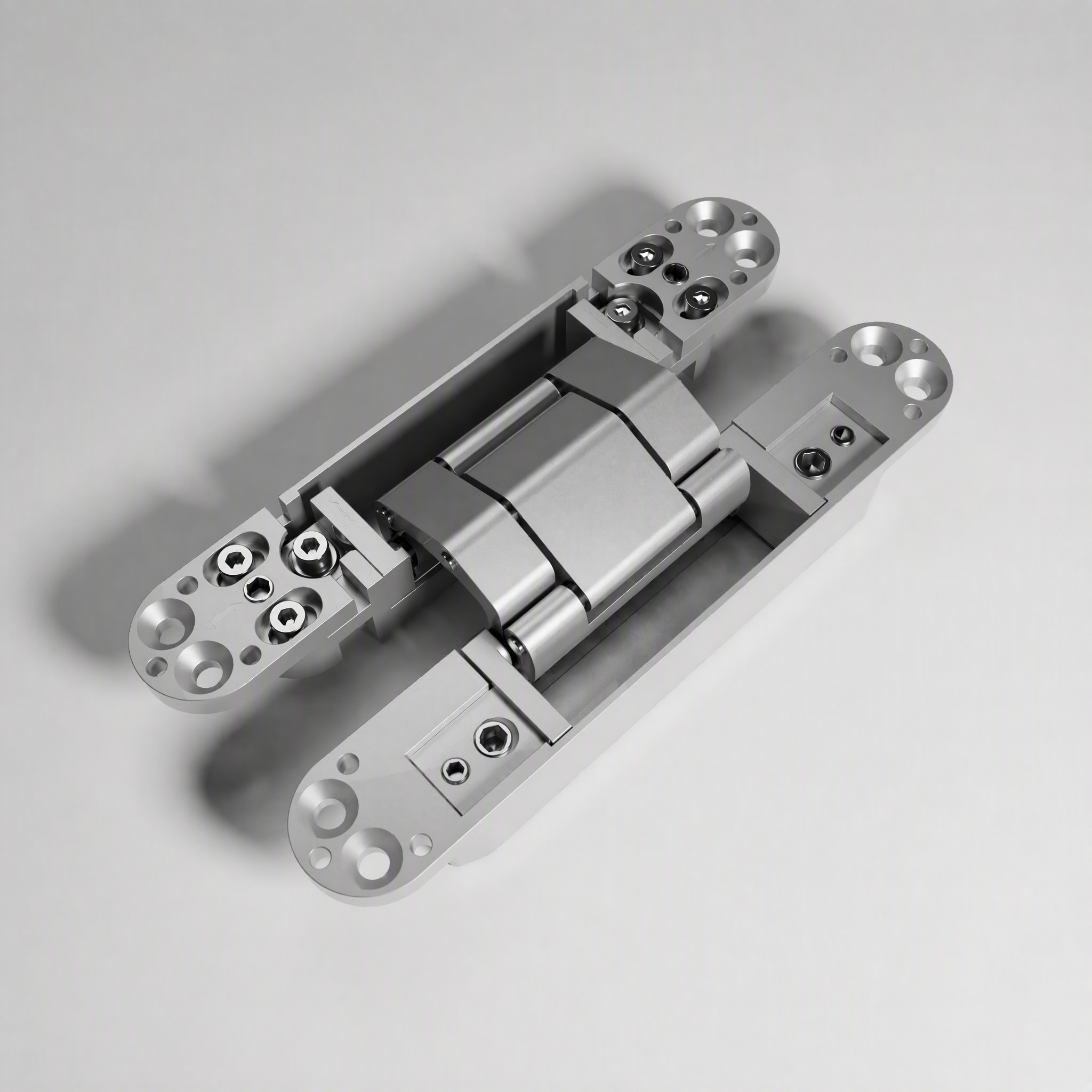
A 3D adjustable concealed hinge is a hinge that is completely hidden inside the door leaf and frame when the door is closed, and can be adjusted on three axes — vertical, horizontal and depth — after the door is already hung. Because the adjustment is made on site with a screwdriver, a door that has settled, a frame that is slightly out of square, or a leaf that sits proud of the frame can be re-aligned without removing the hinge or re-cutting the mortise.
A concealed hinge sits inside a mortise, so once the door is hung there is no visible knuckle to shim, bend or pack. Every correction has to come from the hinge itself. Without adjustment on three axes, a concealed door that is 2 mm out of line has to be taken off, re-mortised and re-hung.
Three axes cover the three faults that actually appear on site:
Adjusting one axis does not disturb the other two, so a fitter can correct the door in three passes instead of starting again.
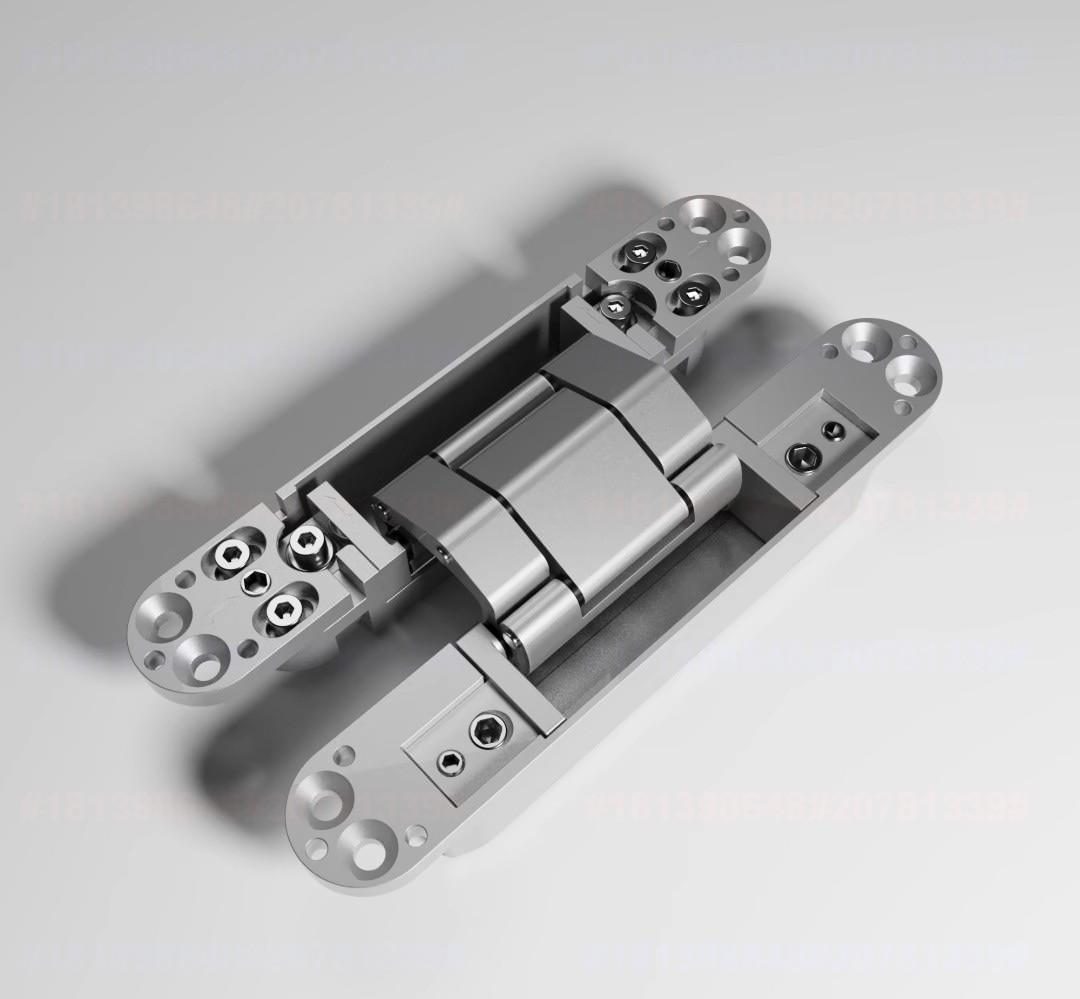
Four ratings — 40 / 60 / 80 / 120 kg — and each one has its own body size and its own mortise, so the rating has to be settled before the door is machined. Where a leaf falls between two ratings, move up one model.
HY-3D 40 — interior, invisible and folding doors. Two hinges, three above 2.1 m door height.
HY-3D 60 — folding doors, invisible doors and medium swing doors. Two hinges carry 60 kg, three carry 90 kg. The mortise is shorter than the 80 kg model (140 against 177) but wider and deeper (30 × 25), which suits narrow stiles. Two hinges, three as door height increases. (on order only)
HY-3D 80 — solid timber and heavier flush doors. Two hinges, three above 2.3 m door height.
HY-3D 120 — oversized, entrance, hotel and commercial doors. Two hinges, three above 2.4 m door height.
Body sizes: 150 × 25 mm for 40 kg, 140 × 30 mm for 60 kg, 177 × 28 mm for 80 kg and 246 × 34 mm for 120 kg — each with its own mortise dimensions, so the rating has to be settled before the door is machined. A 120 kg body will not go into a mortise cut for the 40 kg hinge. If a leaf sits near the top of a rating, or falls between two ratings, move up one model rather than adding a third hinge of the smaller size.
How to tell them apart: look for the two knurled adjusters on the sides of the body. Present, it is the silent hydraulic series; absent, it is the plain load-bearing series. That is quicker than checking a model number.
Load-bearing series — carries the leaf only: no damper, no self-closing, the door is closed by hand or by a door closer. It is still a quiet hinge — the same nylon gaskets sit inside the pivot, so there is no metal-on-metal knock. What it does not do is slow the leaf down.
Silent hydraulic series — the upgraded version of the same hinge: the nylon-gasket construction is identical, and a built-in hydraulic unit is added on top, so the leaf slows down before it meets the frame. Self-closing in four stages. Two knurled adjusters on the body: one sets closing speed (slow ↔ fast), the other switches function (silent ↔ lock); both are marked with a scale. Four anti-pinch limit blocks are supplied and clip on before installation; do not remove them before installation is complete, or the hinge will not open.

Adjust one axis at a time, with the door in the closed position, and check the gap before moving to the next. Each screw holds its setting independently.
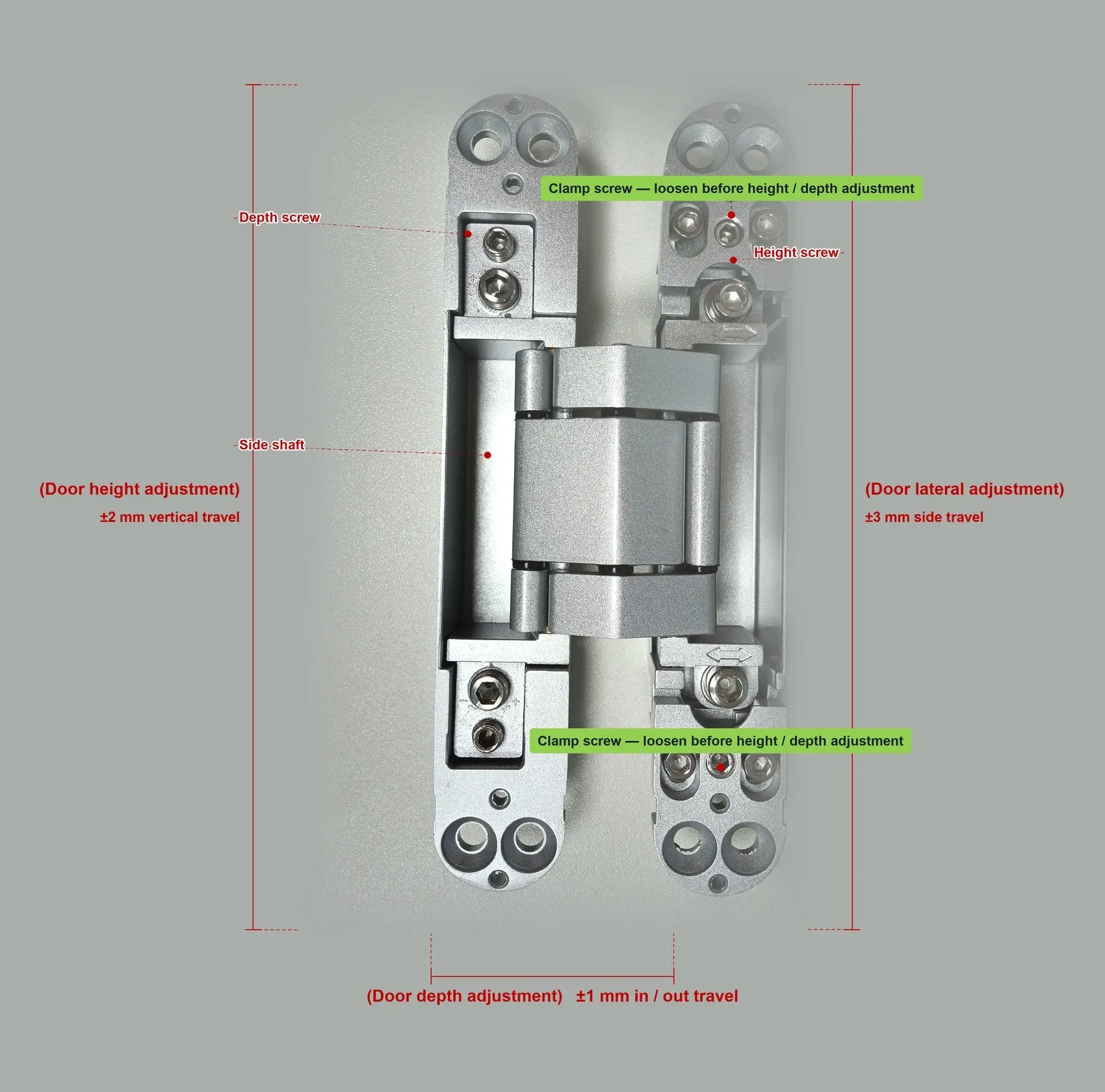
Height: loosen the clamp screws. Depth: loosen the fixing screws. Lateral: loosen nothing. Re-tighten once the setting is made.
Turn the lower height screw. If it runs out of travel, turn the upper height screw in the opposite direction — the pair pushes and pulls as one unit, and turning only one jams the block.
With the fixing screws just slack, press the leaf into the frame plane, then re-tighten. This brings a leaf that sits proud back into line.
Clamp screws stay tight. Turn the central shaft with a 4 mm hex key: left moves the leaf toward the hinge, right tightens. Lateral travel is 1.5 mm on each side, which is 3 mm across the two sides — 3 mm is the total, not the travel in one direction.
Screw positions: height screw, depth screw, side shaft and two clamp screws are marked on the drawing. Travel is height ±1.5 mm, lateral ±1.5 mm on each side (3 mm total), depth ±1 mm, and it is the same on the 40 kg, 80 kg and 120 kg models — only the body size and mortise differ.
A concealed hinge is mortised, not surface-mounted, so the mortise position decides how the door hangs. Each order is supplied with a fitting template and an installation drawing.
Weigh the leaf, not the opening. Choose 40, 80 or 120 kg from the leaf weight, then confirm two or three hinges.
Use the supplied template to mark the mortise on both the leaf edge and the frame. Do not scale from a photo.
Cut to the drawing depth. A mortise that is too deep leaves the hinge sitting behind the face and eats adjustment travel.
Fasten the two halves to the leaf and the frame with the fixings supplied.
Lift the leaf into the frame and engage the hinge. Check the gap before adjusting anything.
Loosen the clamp screw, adjust height and depth, set lateral, then tighten the clamp screw again.
Installation drawing (PDF, with mortise dimensions and hole spacing) is supplied with every order and is available on request before ordering.
The factory drawings for all three sizes, with every dimension in millimetres. Dimensions are in mm and match the table above.


How far it opens, what carries the load, how the anti-pinch blocks work, and what is in the box.
 01180° openingHolds anywhere between 90° and 180°, no spring-back
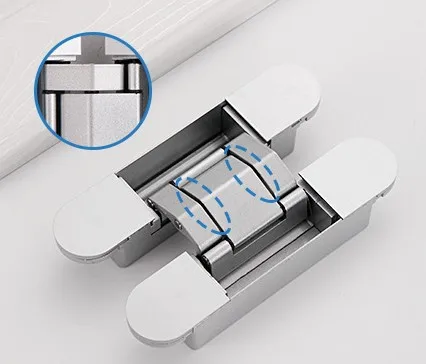 02Load rides on the bearingA thicker bearing and cam take the weight, not thin walls
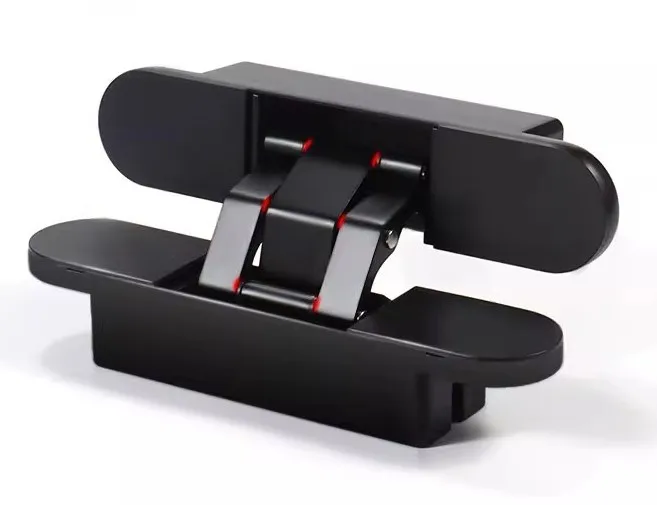 03Eight nylon gasketsSmooth travel, no metal-on-metal knock
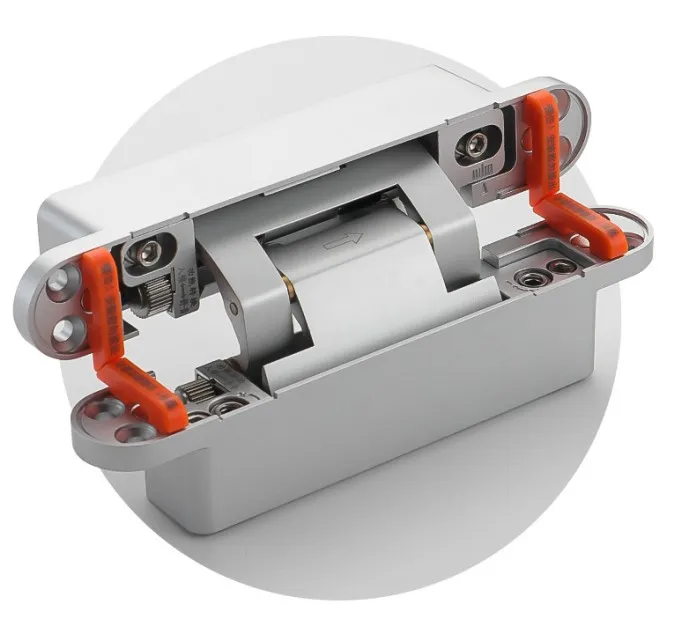 04Four anti-pinch blocksLeave them in until fitting is done, or the door will not open
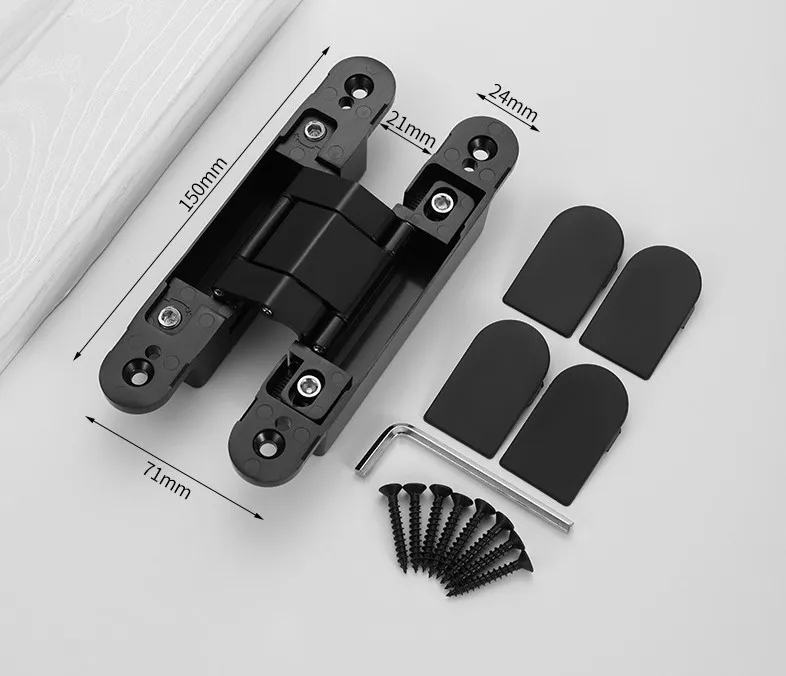 05What is in the boxBody + 4 cover caps + 8 × 5 mm wood screws + 4 mm hex key
The case for a concealed hinge is not only visual. It removes the knuckle that catches clothing and trolleys, keeps the door face flush for cleaning, and — because the hinge is inside the mortise — cannot be lifted off its pins from the outside.
| Application | What drives the choice | Model |
|---|---|---|
| Interior, invisible and folding doors | Flat leaf with no visible knuckle; 35 mm leaf, up to 850 mm wide | HY-3D 40 |
| Concealed hinge for timber door | Solid leaf, movement as the building settles | HY-3D 80 |
| Heavy duty hinge for commercial door | Leaf weight and daily traffic | HY-3D 120 |
| Hinge for high traffic doors | Cycle count — corridor and lobby doors | HY-3D 120 |
| Hinge for hotel room door | Acoustic and fire-rated leaf assemblies, heavy leaf | HY-3D 120 |
| Hinge for hospital / clinic door | Flush, cleanable face; frequent opening | HY-3D 80 / 120 |
| Invisible hinge for wooden door | Visible face must stay uninterrupted | HY-3D 40 / 80 |
Where a project door is fire rated or acoustic rated, the rating belongs to the complete door assembly. The hinge can be supplied to a 1.5–2 hour requirement with in-house test data supplied on request, but the assembly rating still has to come from the door, and the mortise must be sealed after fitting.
The damped version brings the door back on its own. The return is not at a constant speed — it is split into four stages, and the last ten degrees are the slowest, so the leaf settles against the frame instead of hitting it.
The final ten degrees are speed-controlled by the hydraulic unit, so the leaf settles quietly with no knock.
Return speed drops sharply so the leaf does not arrive with momentum.
The main return stage. This is the section the adjusters on the body control.
The door stays where it is put and does not close by itself.
Figures shown as a dash are still being confirmed and will be added before publication.
| Specifications | HY-3D 40 (150 × 25) | HY-3D 80 (177 × 28) | HY-3D 120 (246 × 34) |
|---|---|---|---|
| Model Series | HY-3D Series — three main ratings at 40 / 80 / 120 kg, each with its own body size and mortise dimensions (a 60 kg model is also available, see the note under the table). | ||
| Model No. | HY-3D 40 | HY-3D 80 | HY-3D 120 |
| Body Size (L × W, mm) | 150 × 25 | 177 × 28 | 246 × 34 |
| Max Load Capacity | ≤40 kg per pair | ≤80 kg per pair | ≤120 kg per pair |
| Hinges per Door Set | 2; 3 above 2.1 m door height, 4 on taller doors | 2; 3 above 2.3 m door height | 2; 3 above 2.4 m door height, 4 on taller doors |
| Opening Angle | 180° | ||
| Soft-close Damping (silent hydraulic series) | Hydraulic damped version available — the leaf decelerates automatically near the closed position; damping force adjustable | ||
| Closing Action | Hydraulic self-closing in four stages: fast return at 30–85°, deceleration at 10–30°, silent final approach at 0–10°. Between 90° and 180° the door holds its position and does not close on its own. | ||
| Silent Operation | Eight nylon gaskets inside the pivot — smooth travel, no metal-on-metal knock on opening or closing. Fitted to both series. The silent hydraulic series adds hydraulic damping on top, so the leaf also decelerates before contact and the closing is quieter still. | ||
| 3D Adjustment (up / down, left / right, in / out) | Height ±1.5 mm · lateral ±1.5 mm on each side (3 mm total) · depth ±1 mm. All ratings share the same adjusting mechanism. The hinge is non-handed, and it can be adjusted with the leaf hung, without taking the door down. | ||
| Mortise Size (L × W × D) | 150 × 25 × 22.5 mm | 177 × 28 × 25.5 mm | 246 × 34 × 27.5 mm |
| Mortise End Radius | R12.5 mm | R14 mm | R17 mm |
| Hole Spacing | 121 mm (first hole 6.5 mm from the mortise end) | 145 mm (first hole 9 mm from the mortise end) | 212.5 mm (first hole 9 mm from the mortise end) |
| Locating Hole | Ø3 mm | Ø3 mm | Ø3 mm |
| Fixing Screw | 5 mm wood screw | 5 mm wood screw | 5 mm wood screw |
| Applicable Door Thickness | 35 mm and above | 40 mm and above | 45 mm and above |
| Max Door Leaf Width | ≤850 mm | ≤1000 mm | ≤1400 mm |
| Hinge Body Thickness | 21.55 mm (suits slim frames) | 24.55 mm | 26.5 mm |
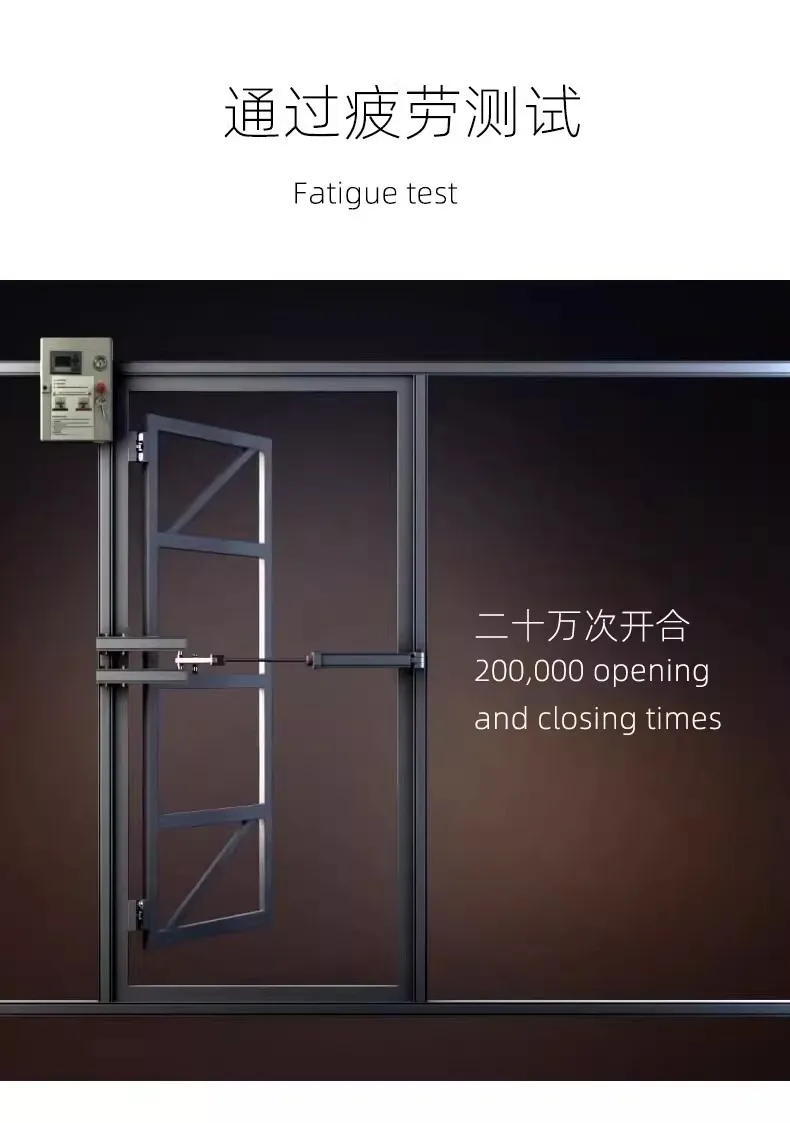
| Service Life (fatigue test) | Assembled hinge run through 200,000 open-and-close cycles on our in-house fatigue rig. The rig is in our plant, so a batch can be re-run at any time, or run to a project's own cycle count. Test report issued on request — in-house data, not third-party certification | ||
| Body Material | Zinc alloy | ||
| Installation Method | Mortised into leaf and frame. Wooden frame — countersunk screws with small shims. Steel frame — a fixing receiver is required. Aluminium frame — the frame maker’s receiver is required and is not supplied with the hinge. | ||
| Fire Resistance | 1.5–2 hours, tested in-house; no third-party certification held | ||
| Salt Spray Test | 48–72 hours | ||
| Surface Finish | Electroplating, electrophoretic coating, PVD, brushing or lacquering — eight standard finishes (GP / PVD / SC / GM / EB / BN / AB / AC), custom on request | ||
| Applicable Door Types | Interior doors / folding doors / invisible doors | Solid timber / heavier flush doors | Entrance / hotel / commercial doors |
| Core Functions | Fully concealed when the door is closed · 3-axis on-site adjustment after hanging · clamp screw must be loosened before height and depth adjustment · 180° opening · zinc alloy body · OEM / ODM to drawing | ||
Also available on order: the 60 kg model (140 × 30) — a non-standard size with a 30 mm mortise width and 25 mm depth, different from the three ratings above. It is not listed in the table and is supplied against a confirmed order.
Note: the figures above are our standard supply specification. The installation manual enclosed in the packaging prevails; for special orders the approved drawing prevails.
This test is not bought from an outside lab: it runs in our own workshop. An assembled hinge is bolted to a test door frame and driven through 200,000 open-and-close cycles. What is tested is the complete hinge as it ships, not a single component worked on a bench.
The rig belongs to us, so any batch can be re-run at short notice, or run to a project's own cycle requirement. The test report is issued on request — it is our own rig data, not third-party certification.
Finish is quoted with the model — the same hinge body is plated, coated or brushed to order. Custom colours can be matched to a sample or a Pantone reference.
500 pcs trial order
8,000 pcs bulk production
Unit price varies by quantity tier
30–35 days after order confirmation
EXW / FOB / FCA
FOB Nansha Port, Guangzhou
T/T 30 % deposit, 70 % against the B/L copy
40 % deposit for the first three orders
30 % from the fourth order onwards
Free of charge
Freight at your cost
Send your courier account
Raw material bought in one lot per order
Colour checked in process
Out-of-tolerance units scrapped, not shipped
Trial quantity applies per item
Models, sizes and finishes combine in one container
Bulk quantity makes a mixed container work
Load plan, carton count and gross weight calculated per order
Palletised or loose, depending on the destination
3 years
Your drawing, your brand, your packaging
Printed installation manual in every carton
Routing dimensions for all four models on this page
Door sag, load ratings, mortising, fire doors, selection and measurement — the twelve questions buyers ask most about this hinge.
Each hinge has six adjusting screws, and the method differs by axis. Work with the door closed, and check the gap after each axis.
Four rules that matter more than the numbers. The clamp screws must be loosened before height and depth adjustment, and re-tightened afterwards. Turning against a tightened clamp screw damages the adjusting mechanism. Leaving a clamp screw loose lets the setting drift within weeks — this is the cause of most “your hinge will not stay adjusted” complaints, and it is not a product fault. Never use a power tool on the adjusting screws.
There are three causes, and they should be checked in this order.
Check in this order: fixing screws tight, clamp screws locked, leaf weight against the rating, then leaf flatness. A door closer that is not matched to the hinge can also pull a door out of line — confirm compatibility before fitting one.
Four ratings: 40, 60, 80 and 120 kg. The figure is per pair — two hinges together, not per hinge. This is the most common misreading, and it is why doors are sometimes specified with a model that is too small.
Weigh the leaf with glass and hardware included. 40 kg suits interior, invisible and folding doors (35 mm leaf, up to 850 mm wide), 60 kg covers folding and invisible doors and medium swing doors (140 × 30 × 25 mm mortise, 35–50 mm leaf), 80 kg solid timber and heavier flush doors, 120 kg oversized, entrance, hotel and commercial doors.
Yes. A concealed hinge is always mortised into both the leaf and the frame — there is no surface-mounted version. Mortise accuracy decides how much adjustment is left for site correction, so a mortise that is too deep uses up travel before the door is even hung.
For the 150 × 25 (40 kg) model: mortise 150 × 25 × 22.5 mm with an R12.5 mm half-round end, locating hole Ø3 mm, hole spacing 121 mm, first hole 6.5 mm from the mortise end, 5 mm wood screws.
Fixing differs by frame material: wooden frame — countersunk screws with small shims; steel frame — a fixing receiver is required; aluminium frame — the frame maker’s receiver is required and is not supplied. Shims are for levelling only, never for making up a wrong mortise depth.
Yes, but the paperwork matters as much as the hinge. We test the hinge to 1.5–2 hours fire resistance on our own test rig, and the in-house test data is available on request. We do not hold third-party fire certification for this range, so we cannot issue a certificate for the hinge on its own — the rating that counts belongs to the complete door assembly and has to be certified by the door manufacturer.
The hinge figure also has to match the door’s own rating rather than replace it, and the mortise must be sealed after fitting — an unsealed mortise leaves an opening through the leaf that is no longer protected.
Use the hydraulic damped version of this hinge. It has a built-in hydraulic damper: as the leaf comes into the last part of its swing it decelerates automatically and settles softly, so the door no longer slams into the frame.
The damping force is adjustable, so closing speed can be tuned to the weight of the leaf. Specify the damped version when ordering.
A 40 kg door takes the 150 × 25 model — HY-3D 40. The size designation is body length × width in millimetres, and it maps directly to the rating: 150 × 25 for 40 kg, 177 × 28 for 80 kg, 246 × 34 for 120 kg.
Use two hinges on a standard door. Weigh the leaf before ordering — a 40 kg leaf on the 40 kg rating leaves no margin, so if the weight sits close to the limit, move up to 80 kg.
Three hinges — top, middle and bottom — on the 120 kg model. Three hinges is not the same as three times the load: the rating applies to the set, and adding a third hinge of a smaller model does not turn a 40 kg hinge into a 120 kg hinge.
Do not mix sizes on one door. Different models have different body sizes and different mortise dimensions, so a mixed set cannot be fitted into one mortise pattern.
Weigh the leaf first — that decides the model — then cut the mortise to that model’s drawing. Measuring the opening does not tell you which hinge you need.
Body sizes: 150 × 25 mm (40 kg), 140 × 30 mm (60 kg), 177 × 28 mm (80 kg), 246 × 34 mm (120 kg).
Selection in six steps: weigh the leaf with hardware; pick the rating; decide two or three hinges; confirm the frame material and whether a receiver is needed; cut the mortise to the model drawing; hang the door, then adjust height, depth and lateral in that order with the clamp screws loosened first.
The assembled hinge is run through 200,000 open-and-close cycles on our own fatigue rig. The rig is in our plant, so a batch can be re-run, or run to a project's own cycle count.
This is in-house testing rather than third-party certification. The test data is available on request, and the same applies to the 1.5–2 hour fire test — the fire rating that counts belongs to the complete door assembly, so in-house data does not make the door rated. If your project requires testing to a named standard, tell us at enquiry stage and we will confirm what can be run.
Trial orders start at 500 pcs per item for the 3D adjustable concealed hinge range, so a model or finish can be sampled and tested before committing to volume. Bulk production starts at 8,000 pcs per item.
Unit price is quoted by quantity tier — the 500-piece trial tier and the 8,000-piece bulk tier sit on different price levels, and intermediate volumes are quoted individually. These terms apply to the 3D range only; other hinge series carry their own MOQ.
Claims are decided by cause rather than by a blanket return window. There are four cases.
Photographs are the first step in every claim. We put our reading of the cause in writing before anything is shipped back, so there is no argument later about which of the four cases applied.
Tell us the leaf weight, door thickness and finish, and we will confirm the model and the price. Drawings and samples are quoted within 24 hours.