Home / Products / General Stainless Steel Hinge Series
Butterfly and butt hinges in 201 or 304 stainless steel — HY-Z for butterfly, HY-E for butt. Four, five and six inch leaves, 2.5 mm and 3.0 mm as standard, two ball bearings, 45 kg per pair. A 2,000 pc trial order is enough to start.
A range of sizes and thicknesses to choose from — 4, 5 and 6 inch as standard, with other sizes made to order.
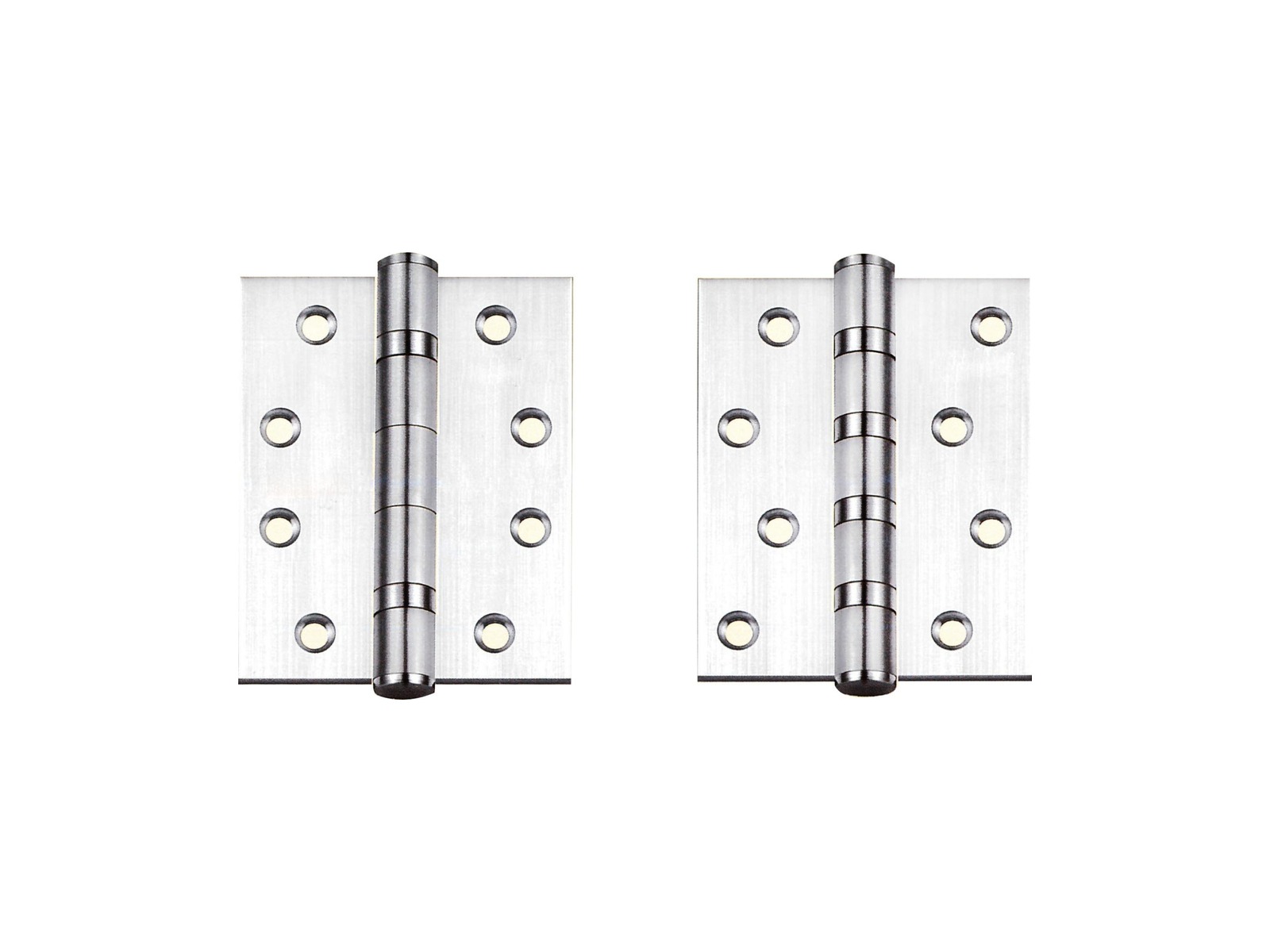
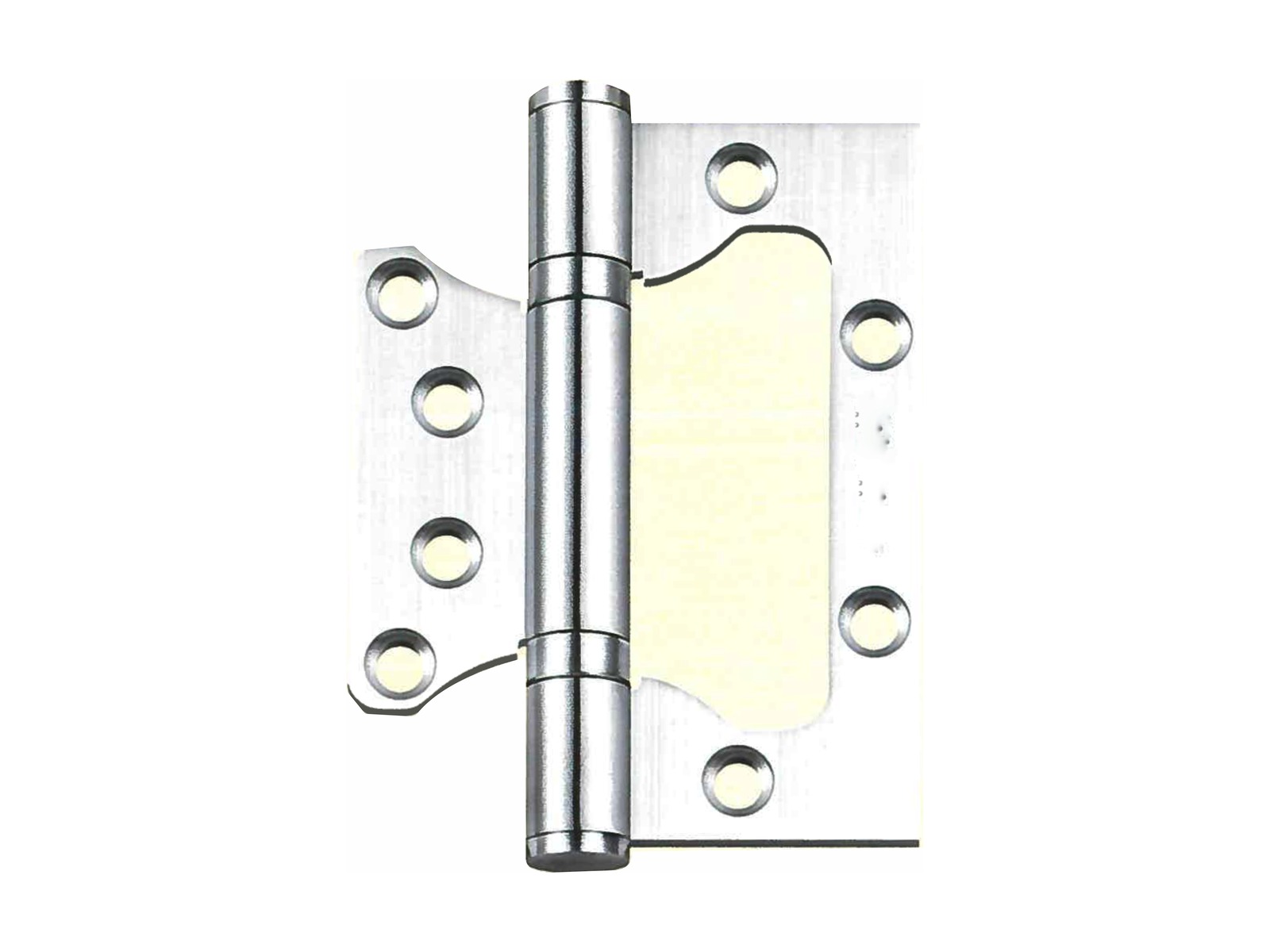
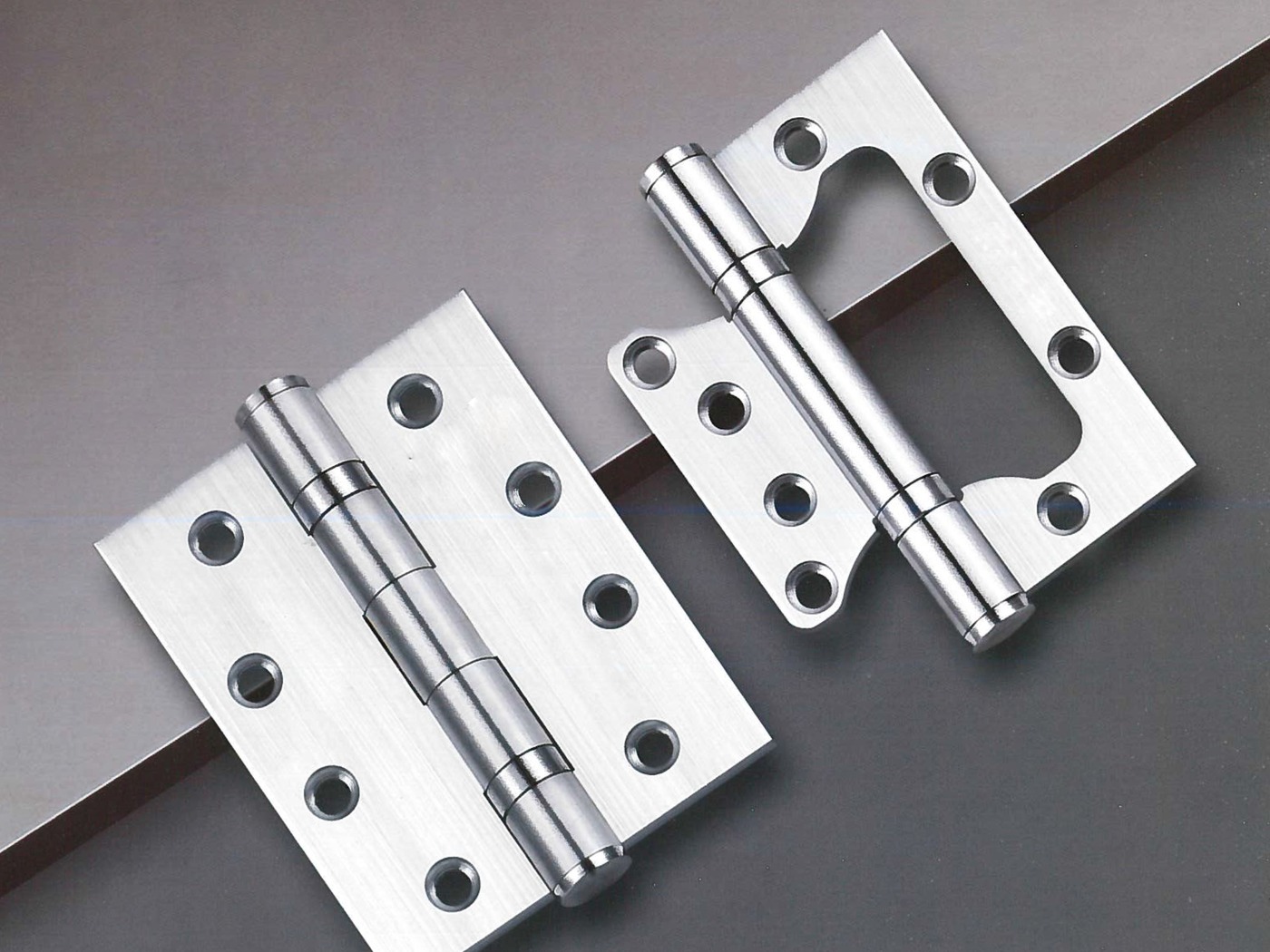
General hinges are butterfly (子母, HY-Z) and butt (平开, HY-E) hinges in 201 or 304 stainless steel — 4 × 3, 5 × 3 and 6 × 3 inch leaves, 2.5 mm and 3.0 mm thick, two ball bearings, rated 45 kg per pair, supplied from 2,000 pcs with FOB Nansha.
This is the range most of our trade customers order without asking questions. It is the hinge that goes on a normal timber door, in a normal building, and keeps working without anyone thinking about it again. Nothing on it is clever, and that is the point — there is no adjustment screw to lose, no hydraulic cylinder to leak, no seal to dry out.
Two shapes, and the difference matters when you specify:
Both shapes share one size code: the size and thickness give the same number, and only the letter changes. HY-Z-435 is the butterfly, HY-E-435 is the butt — same leaf, different structure. The rest of the code is explained under the table.
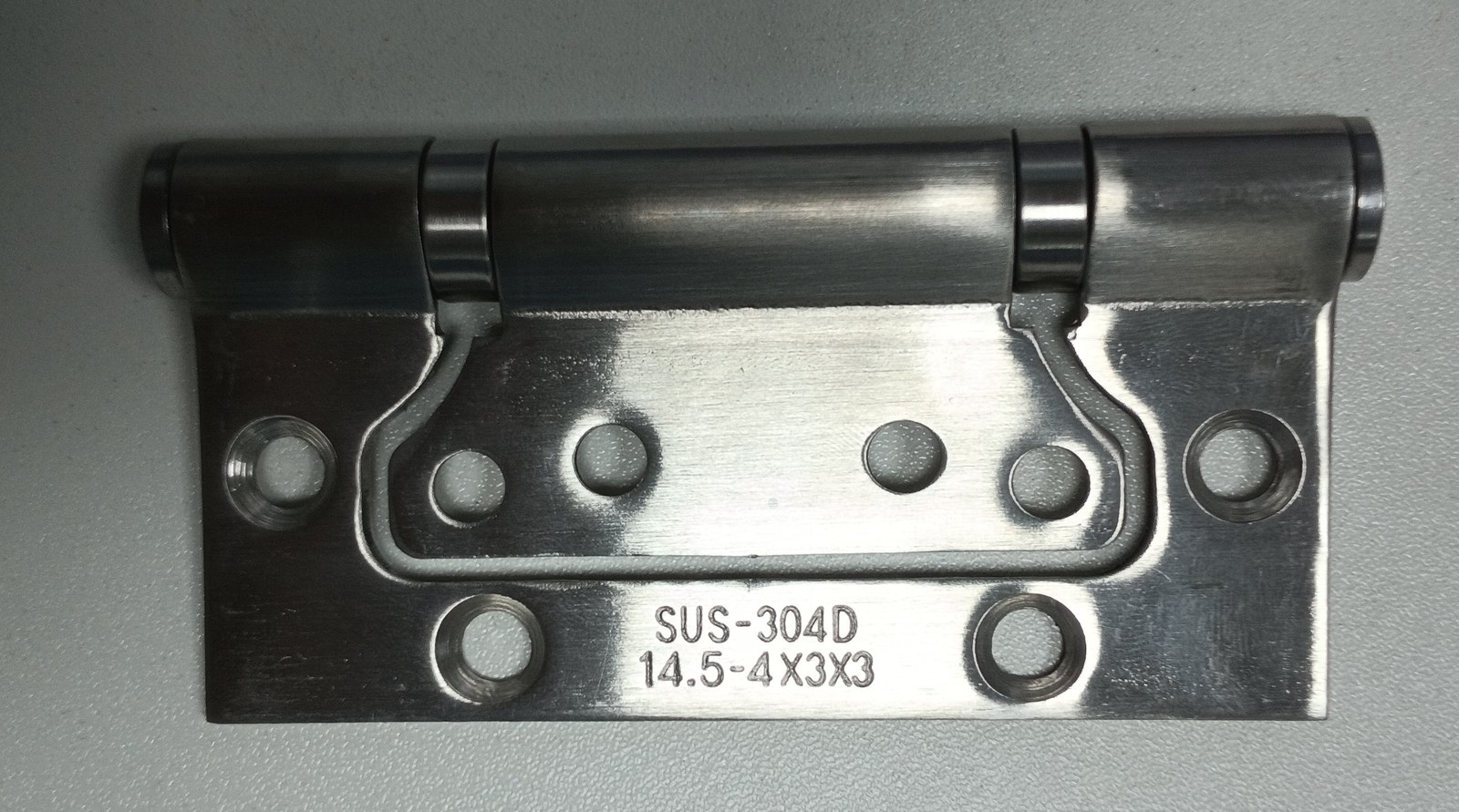
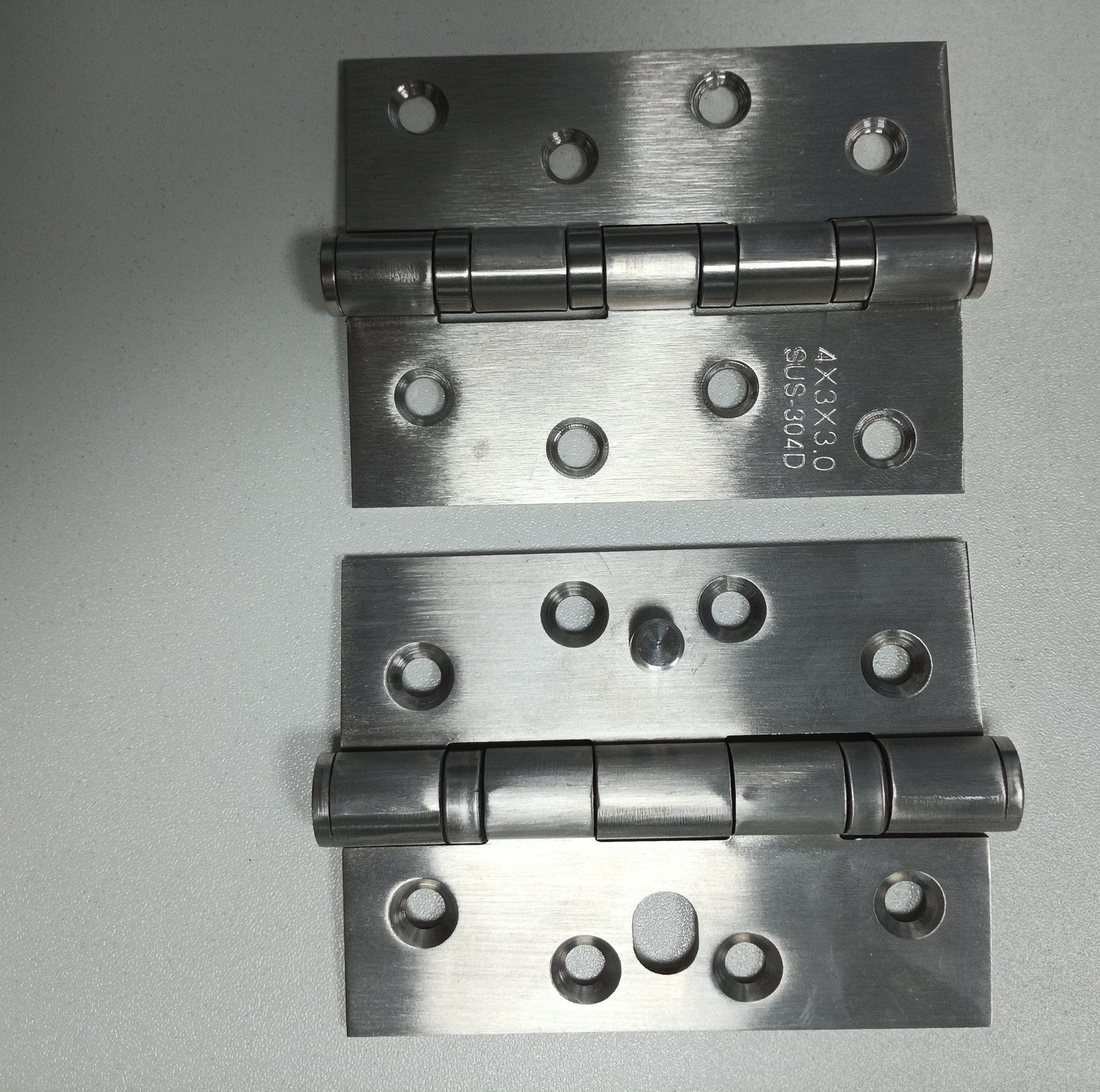
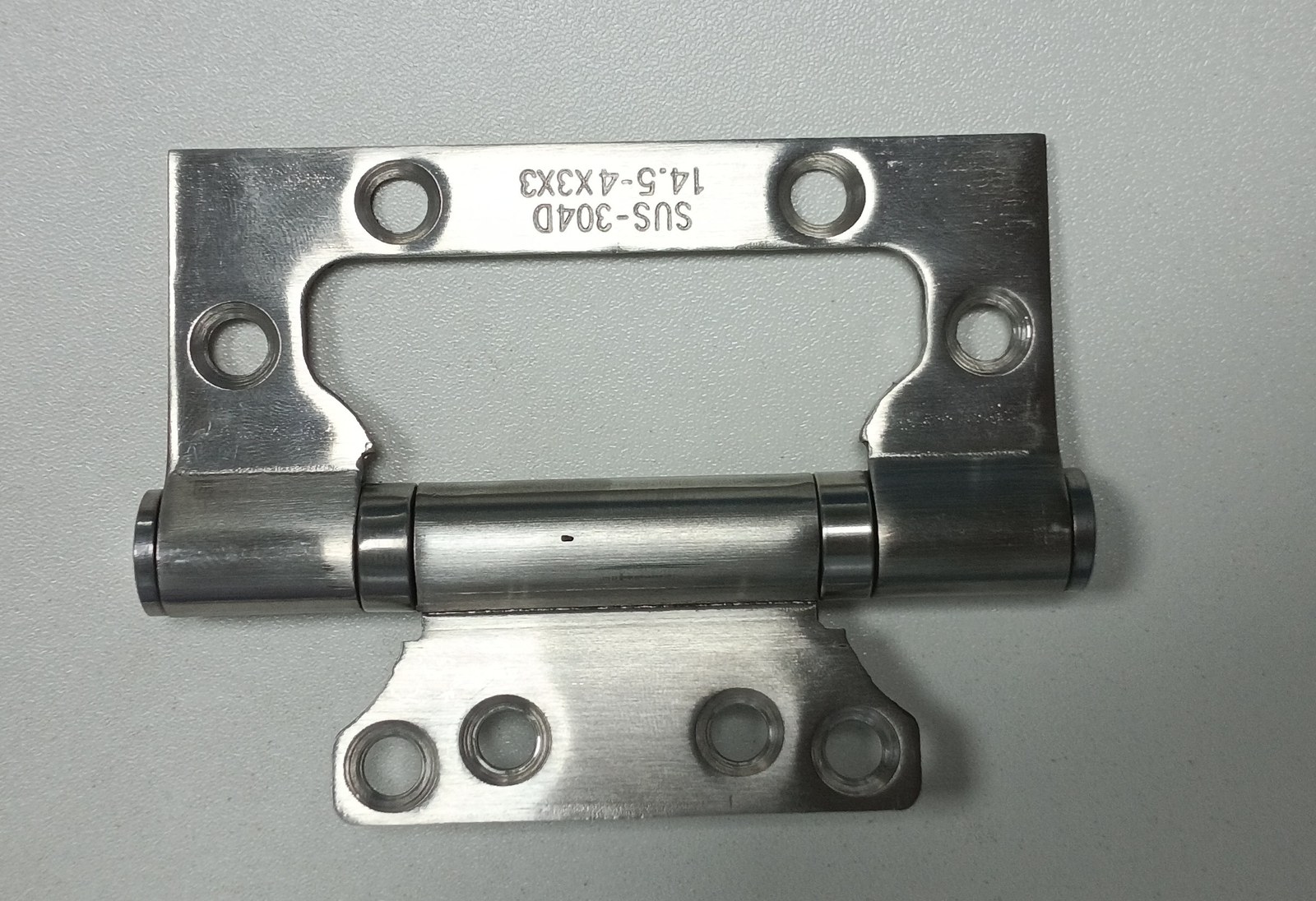
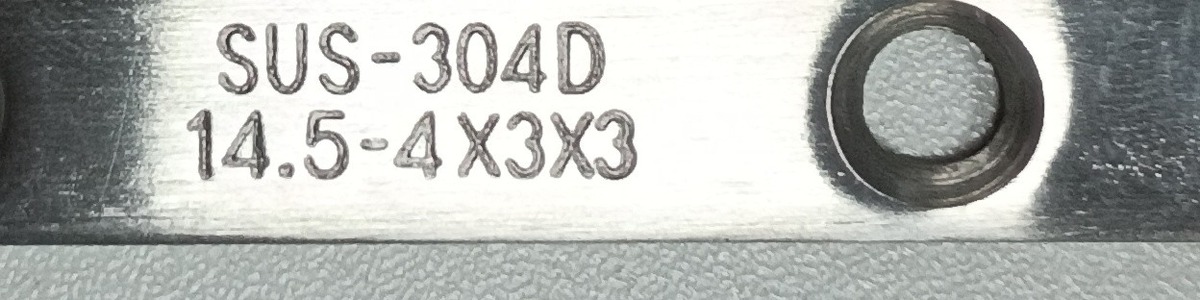
Dimensions are written height × width × leaf thickness, in inches for the first two figures and millimetres for the third — the same way they are written on the carton and stamped on the leaf.
| Size (H × W × T) | Butterfly — HY-Z | Butt — HY-E | Bearing | Availability |
|---|---|---|---|---|
| 4 × 3 × 2.5 | HY-Z-435 | HY-E-435 | 2BB | Standard |
| 4 × 3 × 3.0 | HY-Z-433 | HY-E-433 | 2BB | Standard |
| 5 × 3 × 2.5 | HY-Z-535 | HY-E-535 | 2BB | Standard |
| 5 × 3 × 3.0 | HY-Z-533 | HY-E-533 | 2BB | Standard |
| 6 × 3 × 2.5 | HY-Z-635 | HY-E-635 | 2BB | Made to order |
| 6 × 3 × 3.0 | HY-Z-633 | HY-E-633 | 2BB | Made to order |
| 4 × 3 × 4.0 | HY-Z-434 | HY-E-434 | 2BB | Made to order |
| 5 × 3 × 4.0 | HY-Z-534 | HY-E-534 | 2BB | Made to order |
| 6 × 3 × 4.0 | HY-Z-634 | HY-E-634 | 2BB | Made to order |
Reading the code. The letter is the shape — Z for butterfly (子母), E for butt (平开). The last figure is the leaf thickness, not a version number: 5 = 2.5 mm, 3 = 3.0 mm, 4 = 4.0 mm. So HY-Z-435 is a butterfly on a 4 × 3 inch leaf in 2.5 mm, and HY-E-435 is the same leaf as a butt hinge. The first two figures are the leaf height and width in inches.
4 inch and 5 inch are what the market buys, and they are what we keep tooling for. 6 inch exists and we produce it, but nobody stocks it — plan on a production run rather than a same-week shipment. Above 6 inch the leaves go onto heavy and security doors, quoted from your drawing.
Both grades are stainless steel, both will not rust on a dry interior door, and the price difference between them is real. The difference is what is in the alloy. 304 carries nickel; 201 replaces most of that nickel with manganese. Nickel is what gives 304 its resistance in damp and salt air, and nickel is why 304 costs more.
In practice, for a door inside a heated building, 201 does the job and nobody notices. For a bathroom door, a coastal building, an unheated warehouse or anything that sees condensation, 304 is the grade that lasts — and the price difference is small next to replacing hinges on a finished building.
We do not relabel. Every leaf is stamped with the grade it was made from — SUS 304 or SUS 201 — next to the size. If you order 304 you get 304, and if a buyer checks the stamp on the leaf it will match the invoice. If your enquiry just says “stainless steel”, we will ask you which grade before we quote, because the two prices are not the same and we would rather ask than guess.
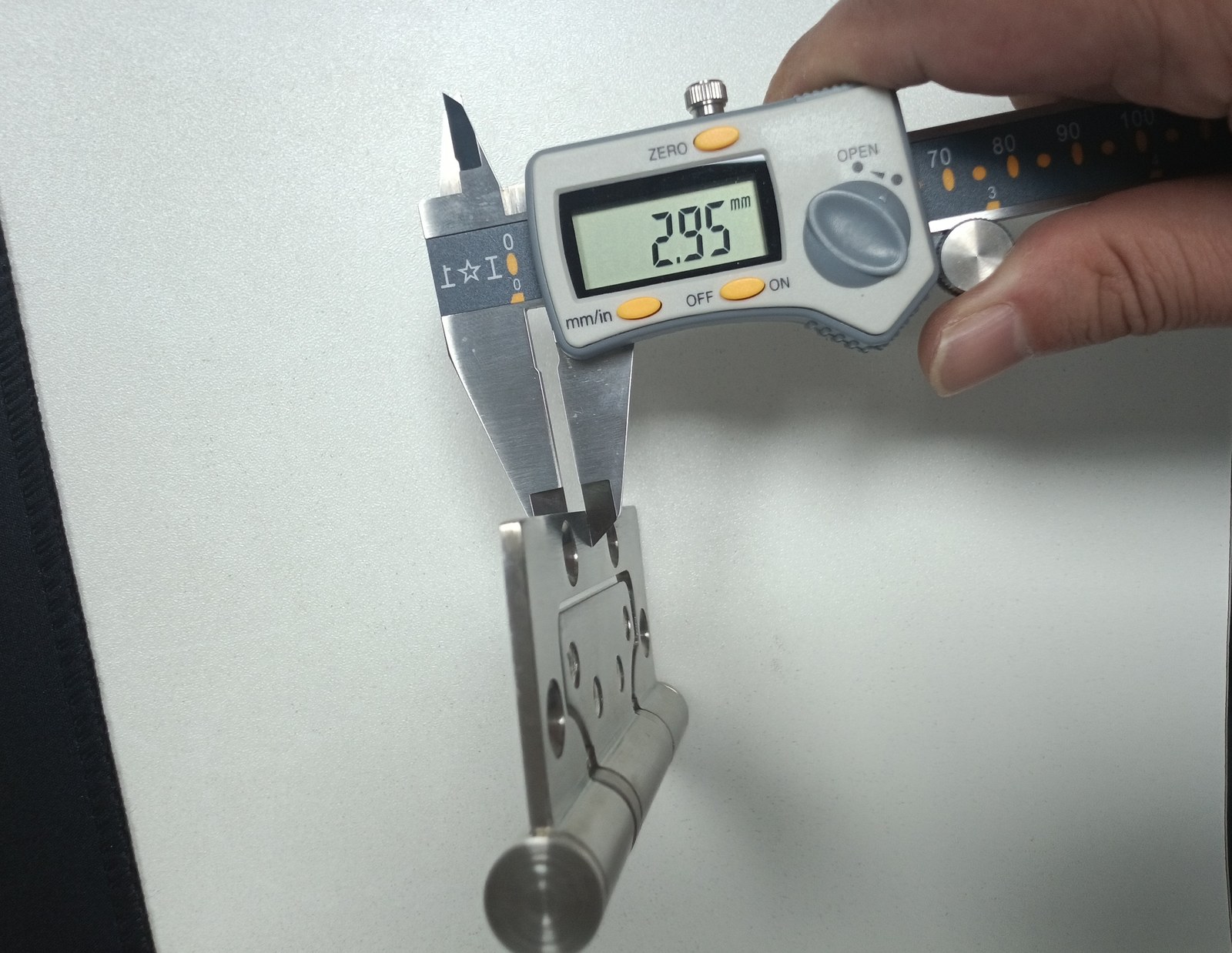
Thickness is quoted as a nominal figure, not an exact one. A 3.0 mm leaf measures between 2.90 and 3.00 mm on a caliper and is supplied as 3.0 mm — anything in that range is the 3.0 grade, not a thin 3.0. The same applies to the other thicknesses.
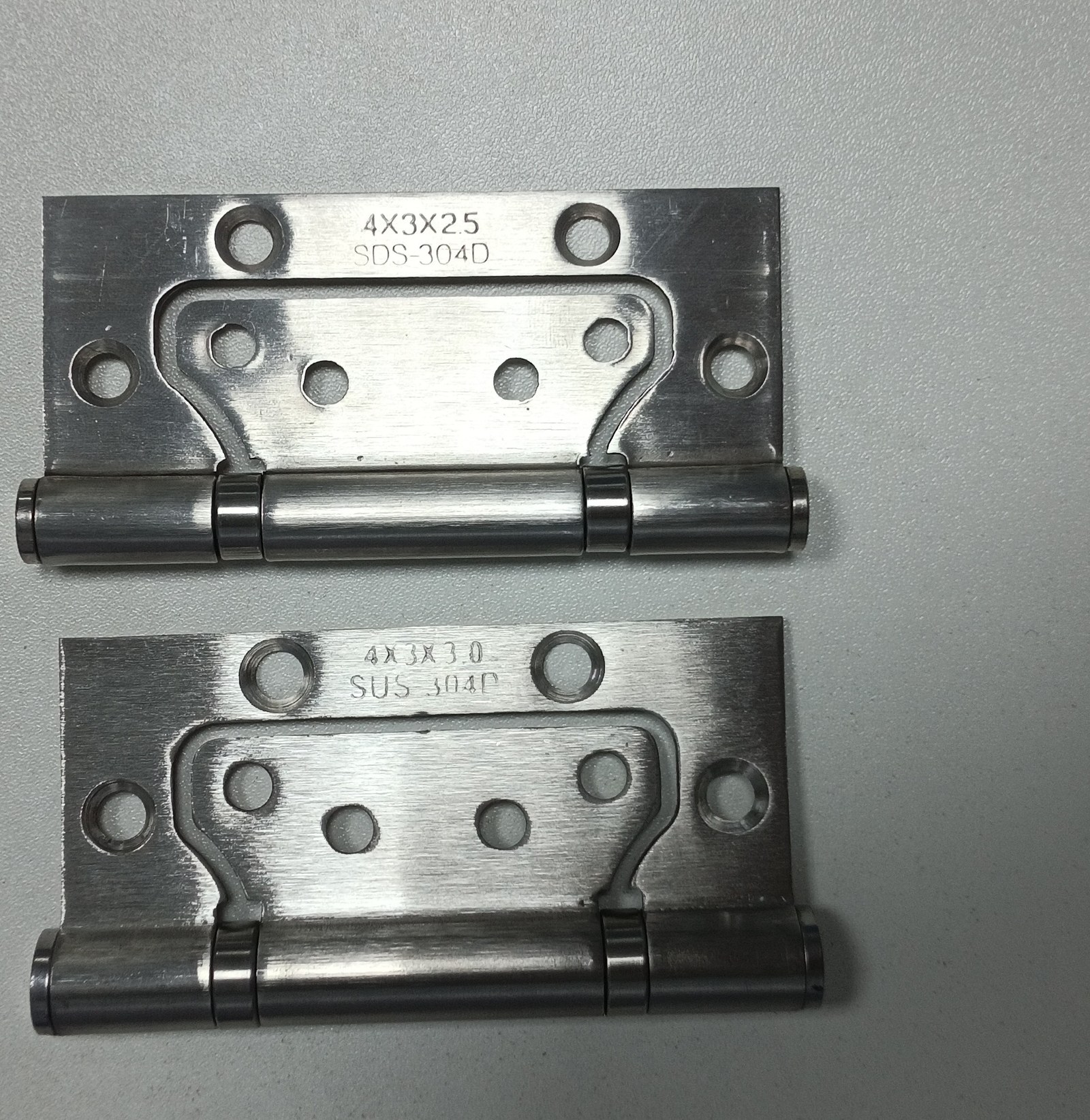
2.5 mm is the lighter leaf, for interior doors and cabinet work where the hinge is not carrying much. 3.0 mm is the one to specify where the door is solid timber, where it is wide, or where the building will be used hard. 4.0 mm we make to order — it is not a stock thickness, and most projects do not need it, but for a heavy leaf or a security door it is available.
The load figure for this series is 45 kg per pair. Per pair means two hinges together, not per hinge — the single most common misreading in hinge specifications, and the reason doors get fitted with a model that is one size too small.
Two hinges carry a standard 2.1 m interior door. A taller leaf, a solid hardwood leaf, or a leaf with glass in it takes three. Weigh the leaf with its glass and hardware in place before you choose, and if the number is close to the limit, step up a thickness rather than adding a hinge in the middle of the door.
| Item | Figure | Note |
|---|---|---|
| Load capacity | 45 kg per pair | Two hinges together. Weigh the leaf with glass and hardware included. |
| Door leaf thickness | 35 mm and above | Thinner leaves need a different hinge — tell us the leaf thickness and we will say which. |
| Hinges per door | 2 standard, 3 on tall or heavy leaves | Standard 2.1 m interior door takes two. |
| Bearing | 2 ball bearings (2BB) | Ball-bearing knuckle, not a plain pin. Smoother travel, and the wear sits in the bearing rather than the knuckle. |
| Rated service life | 300,000 cycles (4 inch) 500,000 cycles (5 inch) | Our own test rating, not third-party certification. See the note on testing below. |
On the cycle figure: the numbers above are the ratings we build to, carried over from the test programme on our hydraulic series. They are our own figures. There is no EN 1935, no CE mark and no UL listing behind them, and we will not pretend there is. If a project requires a certified hinge, this series is the wrong product and we will tell you so before you order.
All eight are applied in-house. The finish is not decoration — on a stainless hinge it is the layer that decides how the door looks in five years, and on a coastal project it is a second line of defence behind the grade of steel.
Brushed stainless is the finish that cannot chip, because there is no coating to chip, and it is what most project work specifies. Black and gun-grey suit modern architecture and black window frames. Gold, brass and the three antique tones are for residential and hospitality work, where the hinge is part of the door design rather than something to hide.
Colours on screen are a guide only. Plating reads differently on every monitor, and a photo cannot show how a brushed surface catches light. Ask for a physical swatch, or send us a photo of the handle or frame you are matching in daylight, and we will tell you which of the eight is closest before you approve a run.
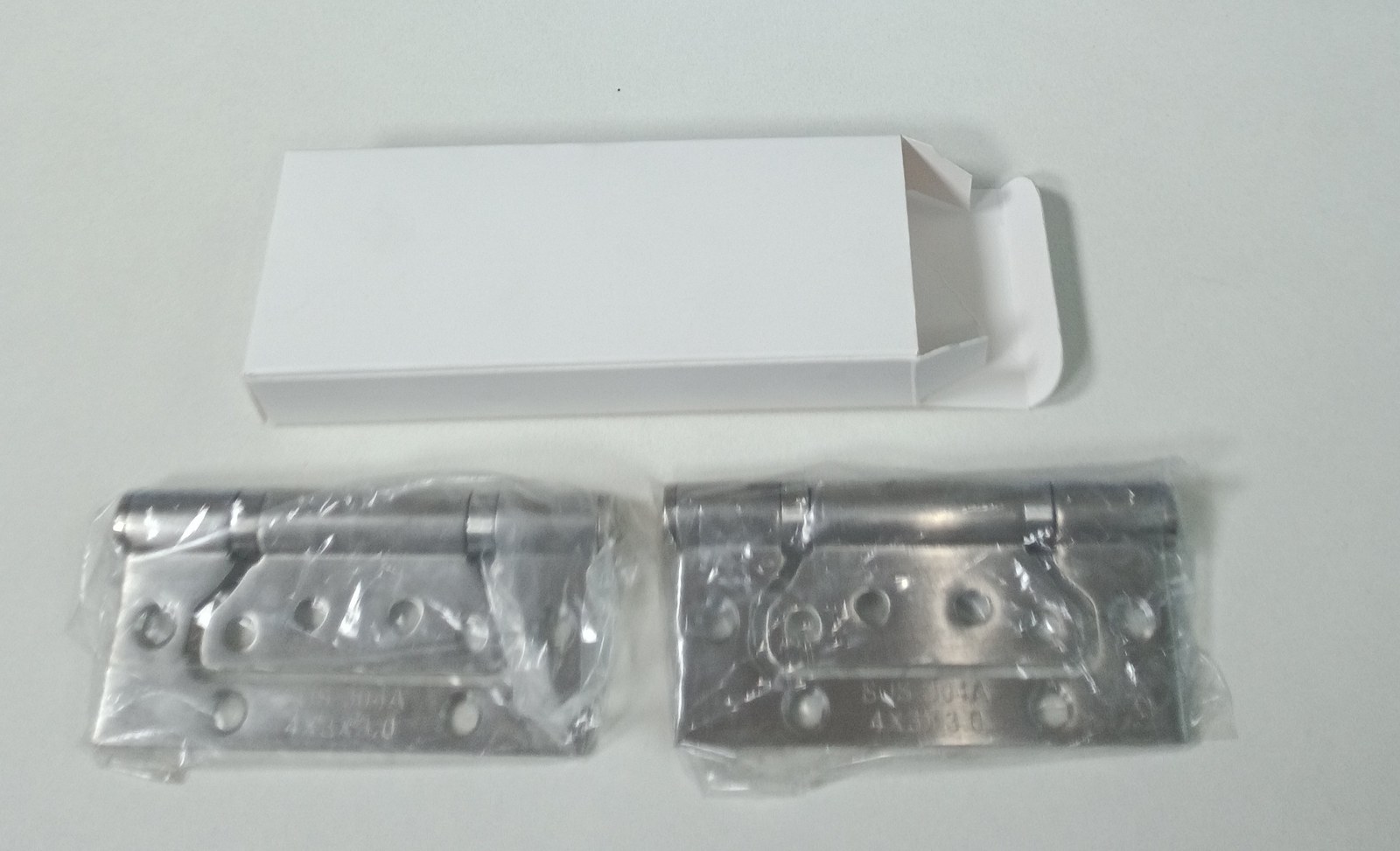
Two hinges to a white box, each hinge in its own poly bag. The bag is not there to protect the finish in transit — the box does that — it is there so a fitter can carry one hinge to the door without marking it, and so the box can be opened and part-used on site without the remaining hinges rubbing against each other.
The box is plain white as standard, which is what most trade buyers want: they label it themselves, or they do not label it at all. If you sell under your own brand, we print your logo and your artwork on the box — that is a carton-level MOQ, not a hinge-level one, and it is quoted with the order.
We are a factory, not a notified body. There are three tests a buyer usually asks about, and here is the honest position on each one:
| Test | Status | What we can give you |
|---|---|---|
| Cycle life | Rated 300,000 / 500,000 cycles | The rating we build to, carried over from our hydraulic series test programme. Ask for the current test status before you specify it for a rated assembly. |
| Salt spray | Run per order | Salt-spray hours for the finish you choose, tested at the hours your project requires. Tell us the hours and the finish, and we will run it. |
| Load | 45 kg per pair, static | Our own load figure. For a project with a specified test method, send the method and we will test to it. |
| Third-party certification | None | No EN 1935, no CE, no UL listing, no test report from an accredited laboratory. If your specification requires one, this series does not meet it. |
We would rather write that down than let a buyer discover it at inspection. If you need a certified hinge for a rated door assembly, tell us at enquiry stage — we will say straight away whether we can supply it, and usually the answer for this series is no. For everything that is not a rated assembly, which is most of the market, the hinge on this page is the one that ships.
2,000 pcs trial order
20,000 pcs bulk production
Unit price varies by quantity tier
30–35 days after order confirmation
EXW / FOB / FCA
FOB Nansha Port, Guangzhou
T/T 30 % deposit, 70 % against the copy of the B/L
First three orders: 40 % deposit
30 % from the fourth order onwards
Free of charge
Freight at your cost
Send your courier account
Raw material bought in one lot per order
Colour checked in process
Out-of-tolerance units scrapped, not shipped
2,000 pcs applies per item
Models, sizes and finishes combine in one container
20,000 pcs makes a mixed container work
Load plan, carton count and gross weight calculated per order
Palletised or loose, depending on the destination
Nothing here is a fixed container capacity
3 years
Your brand stamped on the leaf
Your artwork on the box
Non-standard size from your drawing
Most orders are decided by three things: how heavy the leaf is, how wet the building is, and how often the door moves. The table below is how we answer when a buyer sends a door schedule.
| Where it goes | What drives the choice | We would quote |
|---|---|---|
| Interior room door, timber | Light leaf, dry building, two hinges per door | HY-Z-433, 201 or 304 |
| Apartment entrance door | Solid leaf, handled every day, three hinges on a tall door | HY-Z-533, 304 |
| Bathroom and toilet door | Condensation, frequent use — grade matters more than size here | HY-Z-433, 304 |
| Coastal or near-sea building | Salt air. 201 will stain; 304 is the grade that holds | HY-Z-533, 304 |
| Hotel and serviced apartment | Cycle count, plus a finish that hides handling marks | HY-Z-533, 304, antique bronze |
| School, office, corridor doors | High traffic, wide leaves, three hinges | HY-Z-533, 304 |
| Built-in wardrobe, small door | Light leaf, shallow frame — butterfly shape needs less mortise | HY-Z-435, 201 |
| Heavy or security leaf | Load beyond 45 kg per pair; thickness is the lever | HY-Z-534 / 634, 4.0 mm, 304 |
| Replacement on an existing frame | Match the existing leaf and screw positions before anything else | Send the old hinge dimensions |
If the door is already hung and you are replacing hinges, measure the existing leaf and the screw centres rather than ordering by the door size — a 4 inch hinge from one factory is not always the same hole pattern as a 4 inch hinge from another. If you are specifying new doors, send the door schedule and we will mark it up.
Three ranges do the same job in different ways, and buyers regularly order the wrong one because the price difference is the only thing they compare. The table is the honest version of the difference.
| Item | General (HY-Z / HY-E) | Silent hydraulic | 3D adjustable concealed |
|---|---|---|---|
| Visible when the door is shut | Yes | Yes | No — fully concealed |
| Closing action | Free swing | Hydraulic damping, self-closing | Free swing |
| Adjustable after fitting | No | No | Yes — three axes |
| Load per pair | 45 kg | 40–60 kg | 40 / 80 / 120 kg |
| Minimum order | 2,000 pcs | Ask | 500 pcs trial |
| Relative price | Lowest | Middle | Highest |
| Choose it when | Standard timber door, tight budget, short lead time | The door has to close quietly by itself — hotel, clinic, apartment | The hinge must disappear, or the door has to be re-aligned months after fitting |
The pattern in real orders: a distributor opening a market starts with this general range, because it is the cheapest way to get a container moving and it covers most of what a building actually needs. The same hinges with hydraulic damping come later, when the customer starts asking for doors that do not bang. The 3D adjustable concealed hinge is a different conversation entirely — it sells to door factories and to projects where the architect will not accept a visible knuckle.
All three are made in the same plant on the same floor, so mixing them into one shipment is normal. If you are not sure which one a project needs, send the door schedule and we will mark each door type against a range. Furniture is a separate line: 35 mm cup cabinet hinges for carcass work and built-in joinery.
Nothing here needs a special tool. What decides whether the door hangs straight is the order of the steps, not the skill of the fitter.
Weigh it with glass and hardware in place, measure the thickness, and put a straight edge across the hinge edge. A leaf that is already warped will hang badly no matter how well the hinge is fitted.
Put the hinges as far apart as the leaf allows — top near the head, bottom near the floor — because the distance between them is what resists the door pulling out of square. A third hinge goes in the middle of the span.
Mark both from the same datum with the door temporarily in place. Marking the leaf and the frame separately is how hinges end up a few millimetres out of line, and the error cannot be adjusted out afterwards.
The mortise depth should equal the leaf thickness of the hinge, not more. A shallow mortise leaves the hinge standing proud and the door will not close; a deep one leaves a gap you cannot shim away cleanly.
Fix the leaf side first, hang the door, then fix the frame side with the door held in its final position. Check the gap at the top, the lock side and the bottom before driving the last screws.
Tighten the screws evenly, a little at a time, working across the leaf rather than around it. Driving one screw fully home first pulls the leaf plate out of flat and puts a permanent twist in the hinge.
These five account for most of the “your hinge is faulty” messages a hardware supplier receives. In every case the hinge was fine when it left the factory.
| Fault | What happened | The fix |
|---|---|---|
| Mortise packed out | The mortise was cut too deep and packed with card or shims to bring the hinge back to the face. The pack compresses, the hinge moves, the door drops. | Re-cut or re-hang. Packing is not a repair. |
| Screw holes split the leaf | Screws driven straight into hardwood without pilot holes. The split is invisible until the door is hung, then the screw will not hold. | Pilot drill every hole, and use the screw gauge we supply. |
| Two hinges on a heavy leaf | The leaf was over 45 kg, or taller than 2.1 m, and two hinges were used anyway. The top knuckle wears first and the door drops at the lock side. | Add the third hinge and step up a leaf thickness. |
| 201 in a wet room | 201 was substituted for 304 to save cost on bathroom or coastal doors. Surface rust appears at the knuckle and screw holes within a season. | There is no fix except replacement. Specify 304 for anything wet. |
| Finish damaged during decoration | The hinge was left in place while the door was painted or plastered. Solvent and abrasive dust mark the finish, and paint in the knuckle stiffens the bearing. | Mask the hinge, or remove it and refit after decoration. |
If a claim does come in, send photographs of the hinge in place before it is removed, plus the stamp on the leaf and the carton label. Those three together tell us the grade, the batch and whether the fault is in the product — and they let us answer within a day instead of a week.
Grade, thickness, load, quantities and paperwork — the questions that come up before a first order.
A butterfly hinge — 子母 in Chinese, also called a mother-and-child hinge — has two leaves of different widths. The narrow leaf sits in the frame and the wide leaf carries the door, so the frame needs only a shallow mortise. A butt hinge has two leaves of equal width and needs a full mortise on both the frame and the leaf.
Choose butterfly where the frame is thin or where you do not want to cut deep into it; choose butt where both leaves are full width and you want the maximum load from the same leaf size. Both are the same price at the same size and thickness in this series, so the choice is a fitting decision, not a cost decision.
304 for anything that sees moisture, salt air or condensation — bathrooms, coastal buildings, unheated warehouses, exterior doors. 201 for dry interior doors in a heated building, where it performs the same and costs less.
The two are not interchangeable in a wet environment, and the failure is not immediate: a 201 hinge in a coastal bathroom looks fine at handover and then starts to show surface rust at the knuckle and around the screw holes. By then the building is handed over. If you are unsure which environment your order is going into, tell us the city and the building type and we will recommend one rather than quote both.
Height × width × leaf thickness. The first two figures are in inches, the third in millimetres: a 4 × 3 inch leaf that is 3.0 mm thick. The model number carries the same information in shorthand, with one letter in front for the shape — Z for butterfly, E for butt. So HY-Z-433 is a butterfly and HY-E-433 is a butt on that same leaf, because the last digit is the thickness code (3 = 3.0 mm, 5 = 2.5 mm, 4 = 4.0 mm).
So HY-Z-435 and HY-Z-433 are the same leaf at two different thicknesses, not two different sizes. This is worth checking on a competitor quotation, because a “4 inch hinge” on its own says nothing about the thickness, and the thickness is where the cost is. The letter matters just as much when you order: quoting HY-Z when the job needs a butt hinge gets you the wrong product in the right size.
45 kg per pair — two hinges, not one. Weigh the door leaf with its glass, its lock and its handles fitted, because that is the weight the hinges actually carry.
If the leaf comes out close to 45 kg, do not simply add a third hinge and keep the same model: adding a hinge shares the load but does not increase the capacity of each knuckle. Step up to a thicker leaf or a larger size instead, and use three hinges as well if the door is tall.
Two for a standard 2.1 m interior door. Three for a taller leaf, a solid hardwood leaf, or a leaf with glass in it. Four on a door above roughly 2.4 m, or on a very heavy leaf.
The rule behind it is that the top hinge carries most of the load and the bottom hinge carries the leverage, so a tall door with two hinges puts a bending load on the top knuckle that it was not designed for. If you send us the door schedule with heights and leaf weights, we will mark the hinge count on it.
35 mm and above. Below that there is not enough timber for the screws to hold, and the hinge will pull out of the leaf rather than wear out — a different failure with a different fix.
If your leaf is thinner than 35 mm, tell us the thickness before ordering and we will quote a hinge that suits it. Thin-leaf doors are usually cabinet or lightweight partition doors, and a different product from this range is the right answer.
Yes. Your logo or brand name can be stamped on the leaf alongside the grade and size, and your artwork can be printed on the white box. Both are OEM items quoted with the order.
One thing to plan for: the stamping tool is made per design, so the first order carries a one-off tooling cost that later orders do not. Send the artwork as a vector file if you have one — a photograph of an existing stamp is workable but slower, because we have to redraw it before we can cut the tool.
2,000 pcs per item for a trial order, 20,000 pcs for bulk production. The unit price is tiered by quantity, so the price at 2,000 and the price at 20,000 are not the same number.
2,000 is deliberately low for a hardware item — it is set so a distributor can test a market without committing to a container. If you want to combine several sizes and finishes into one trial order, that is normal: the 2,000 figure applies per item, and we quote the whole basket together.
Two hinges to a white box, each hinge in its own poly bag. The box is plain as standard; your logo and artwork can be printed on it, and a colour box is available as an OEM option.
Cartons are export-packed for sea freight. If your market needs retail-ready packaging — a hanging card, a printed blister, a barcode on the box — say so at enquiry stage, because retail packaging changes the carton dimensions and the freight calculation.
We have our own test data and no third-party certification. There is no EN 1935, no CE mark and no UL listing on this series, and no report from an accredited laboratory.
What we can do is run salt spray to the hours your project specifies, and test load to your method, and send the results. That is factory data, and it is honest data — it is just not the same thing as a notified-body certificate. If your specification calls for a certified hinge, this is the wrong product and we would rather lose the order than have you find out at inspection.
Yes to both, as made-to-order items. 4 inch and 5 inch in 2.5 mm and 3.0 mm are the sizes we hold tooling for and the sizes the market buys; 6 inch and 4.0 mm are produced against a confirmed order.
Above 6 inch is also possible for heavy and security leaves, made to order — we quote from the leaf dimensions, thickness and hole spacing. Production lead time is longer than for stock sizes, so plan the order around it.
30–35 days after order confirmation for standard sizes, longer for made-to-order sizes and for OEM packaging. We ship EXW, FOB or FCA — FOB from Nansha Port, Guangzhou.
Warranty is 3 years on the hinge. Payment terms are confirmed with the quotation, and they depend on whether it is a first order or a repeat. For a first order we will always quote the full specification in writing before you commit, including the grade, the thickness and the finish, because those are the three things that decide whether the price you were quoted is the price of the product you expect.
Trade terms: EXW / FOB / FCA — FOB Nansha Port, Guangzhou. Lead time 30–35 days after order confirmation. Payment: T/T 30 % deposit and 70 % against the B/L copy, with a 40 % deposit for the first three orders. Full ordering terms.
Claims: quality defects confirmed as ours are refunded or replaced in full with freight on us; short shipments are topped up free of charge. Transit damage sits with the carrier because we sell FOB. The four claim cases in full.
Tell us the leaf size, the thickness, the grade and the quantity — or send the door schedule and we will mark it up. We reply within 24 hours.