Home / Products / HY-L · HY-H · HY-T
Three heavy patterns out of one workshop: an industrial hinge built on a thickened base, a precision H hinge for doors that must never work loose, and a self-closing spring hinge whose force you can set. All in 201 or 304 stainless, made to your drawing rather than to a stock list.
These three sit outside the numbered general range because they are not bought by the box for a standard door. They are bought by the project: a heavy architectural leaf, a flush-frame wardrobe, a gate that has to swing itself shut. Each one solves a different mechanical problem, and the difference between them matters more than the finish does — picking the wrong pattern is how a door ends up dragging six months after handover.
Before the detail, the one-line version. If you already know which of these problems you are solving, skip to the section.
| Pattern | How it mounts | The problem it solves | Typical door |
|---|---|---|---|
| HY-L | Industrial hinge on a thickened, reinforced base | A leaf heavy enough that a standard hinge works loose at the screws | Grand residential entrance, heavy timber, oversized architectural leaf |
| HY-H | Two long plates, barrel centred between them, screwed flat | A frame with no rebate to mortise into, where the load has to spread along the plate | Flush and overlay doors, wardrobe and cabinet leaves, heavy flush panels |
| HY-T | Spring-loaded knuckle, self-closing | A door that has to close itself, without a floor spring or an overhead closer | Swing doors, gates, storeroom and utility doors, anywhere a closer would be in the way |
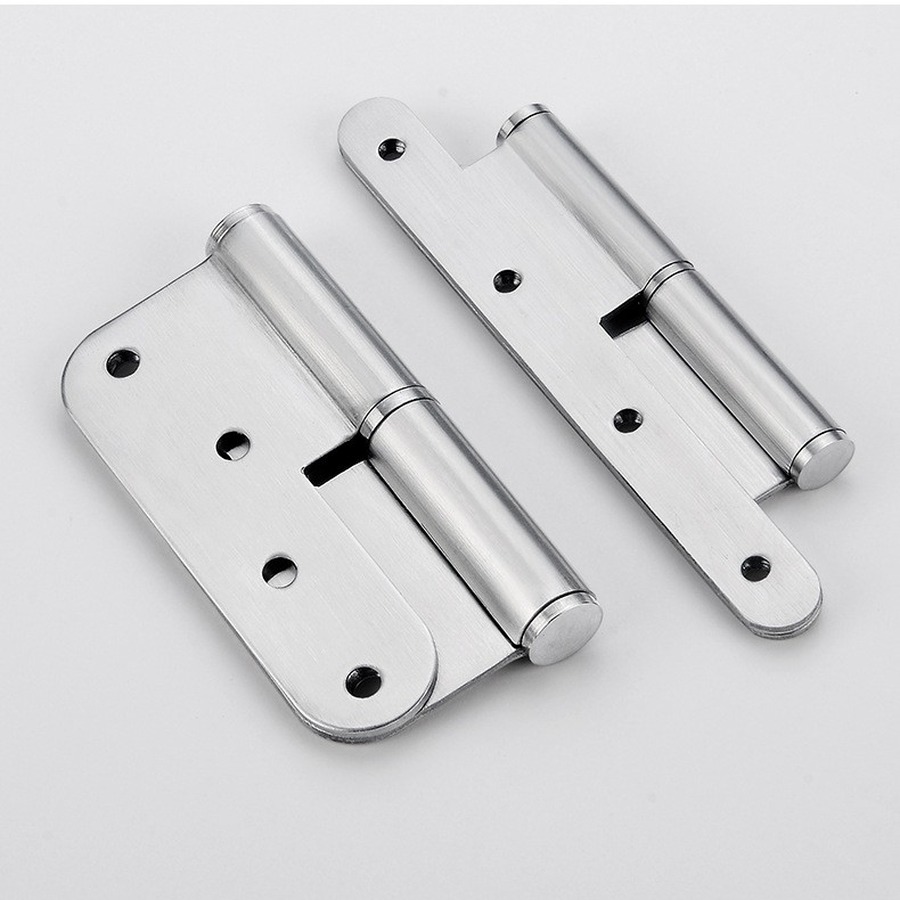
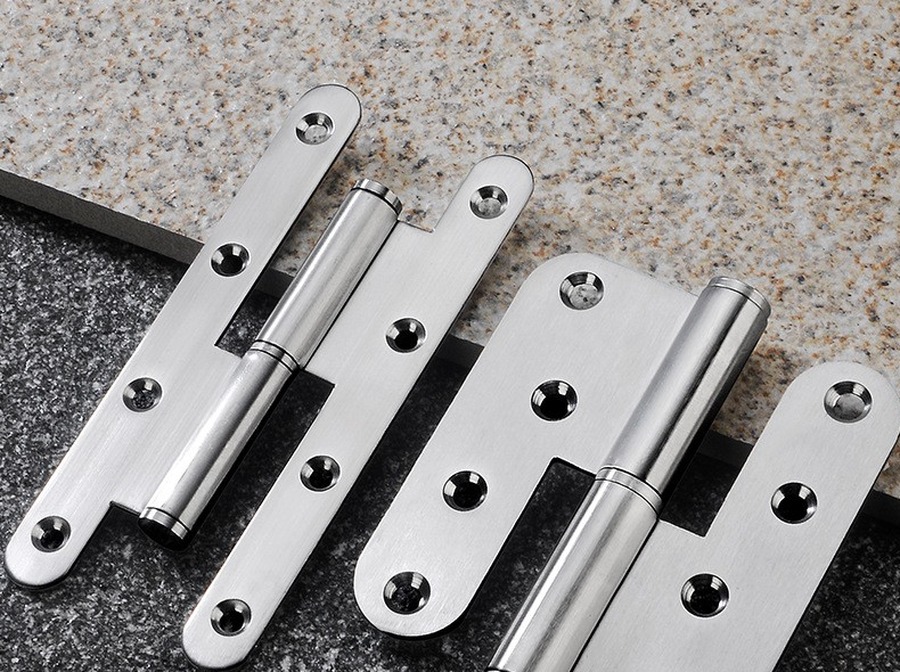
The reason these are catalogued together is that they share a supply chain rather than a function: the same press, the same polishing line, the same batch records. A buyer fitting out one building often needs two of the three on the same order — an H hinge on the wardrobe run, a spring hinge on the utility doors — and it is easier to hold one supplier to one colour standard than three.
This is the whole range as it is ordered: two patterns, two plate lengths each, both handings. Nothing else is a standard item, and anything else is quoted as non-standard.
| # | Pattern | Corner | Plate length | Handing |
|---|---|---|---|---|
| 1 | L pattern | Rounded | 100 mm | Left opening |
| 2 | L pattern | Rounded | 100 mm | Right opening |
| 3 | L pattern | Rounded | 140 mm | Left opening |
| 4 | L pattern | Rounded | 140 mm | Right opening |
| 5 | H pattern | Square | 110 mm | Left opening |
| 6 | H pattern | Square | 110 mm | Right opening |
| 7 | H pattern | Square | 140 mm | Left opening |
| 8 | H pattern | Square | 140 mm | Right opening |
In the standard list the corner and the pattern travel together: rounded goes with the L pattern, square with the H pattern. The two are discussed separately below because that is how the decision gets made in practice — but if you are ordering from this page, pick a line from the table and stop there.
The plate ends in a radius, so the opening has to end in the same radius. That is the whole difficulty: cut the recess square and the four corners either stand proud of the frame or sit in a gap. The rebate is either cut with a radiused cutter or worked by hand at each corner — and that extra hour is what separates a rounded job that looks right from one that looks almost right.
What you buy with it: a softer line in the sight line, no sharp point to catch a sleeve or a cleaning cloth, and no corner to chip on a painted or lacquered door. On domestic joinery and higher-end interior work this is the one people notice — not because they can name the detail, but because the door looks finished.
Straight cuts, square corners, one pass of the router or the chisel. Nothing has to follow a radius, a frame that is not perfectly true still accepts the plate, and across a batch of doors the fitting time per door drops noticeably.
The trade is visual: four hard corners sitting in the sight line, and on a painted or lacquered leaf that square corner is the first place to chip. On an industrial or architectural detail it reads as deliberate; on a period interior it reads as a shortcut.
The two patterns, side by side. Shape first: the L is short and wide, the H is long and narrow. The corner profile is a separate line on the order, and it is what the two columns above are about.
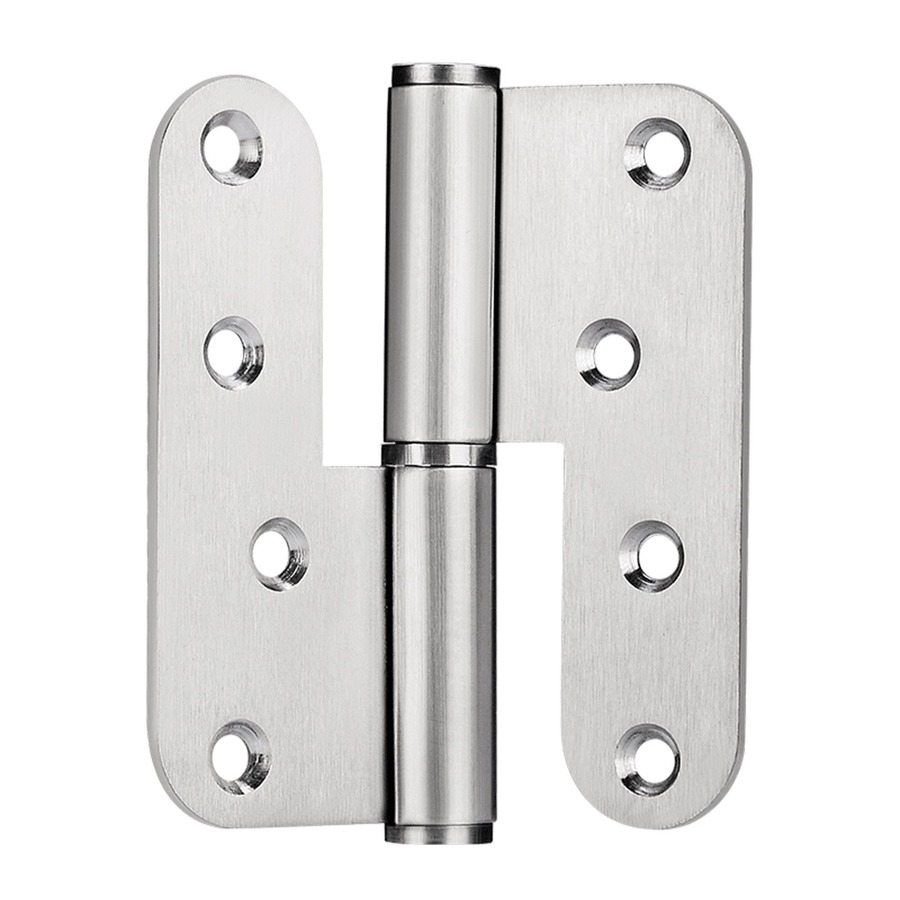
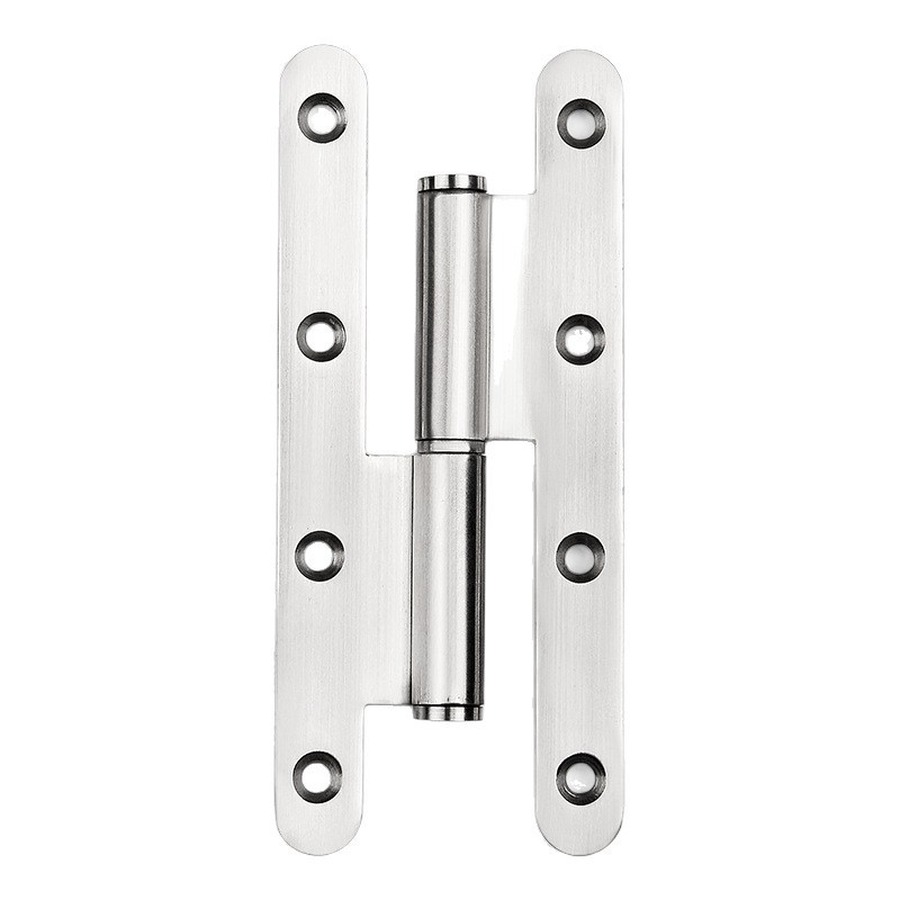
| If the frame is… | Take | Why |
|---|---|---|
| Straight-cut opening, and a fitter who wants it simple | Square — H | Three straight cuts, no radiused corner to work — quickest per door |
| Visible joinery, where the corner sits in the sight line | Rounded — L | Softer line, nothing to chip — the price is a recess cut to the radius |
| An opening already cut square and finished | Square — H | Do not re-cut a finished frame; the plate must match what is already there |
| Painted, lacquered or a light-coloured finish | Rounded — L | Less likely to chip or mark at the corner in service |
| Narrow stile, where 90 mm will not sit flat | H at 60 mm across | The long narrow plate is the only one of the two that fits the timber |
| Heavier leaf — glazed, solid core, closer fitted | L, in 140 mm | Wider plate and the 80 kg pair rating; use three on a tall leaf |
Both patterns come in two plate lengths: L at 100 and 140 mm, H at 110 and 140 mm. The length is not a door size — it is the amount of bearing area, and on a heavy leaf the longer plate is doing work that a third hinge would otherwise do.
Every line is handed. The plate is not symmetrical, so a left cannot be turned into a right and a mixed delivery means a second shipment. State left or right on the order, and if it is not obvious from the drawing, send a photo of the door edge with the old hinge in place — conventions differ between markets, and two people standing on opposite sides of the same door will describe it opposite ways.
Rounded on an H plate, or square on an L plate, both come off the same tooling — but they are quoted as non-standard, with their own minimum, because they are not lines we hold. Ask if a project needs one; do not assume it is on the shelf.
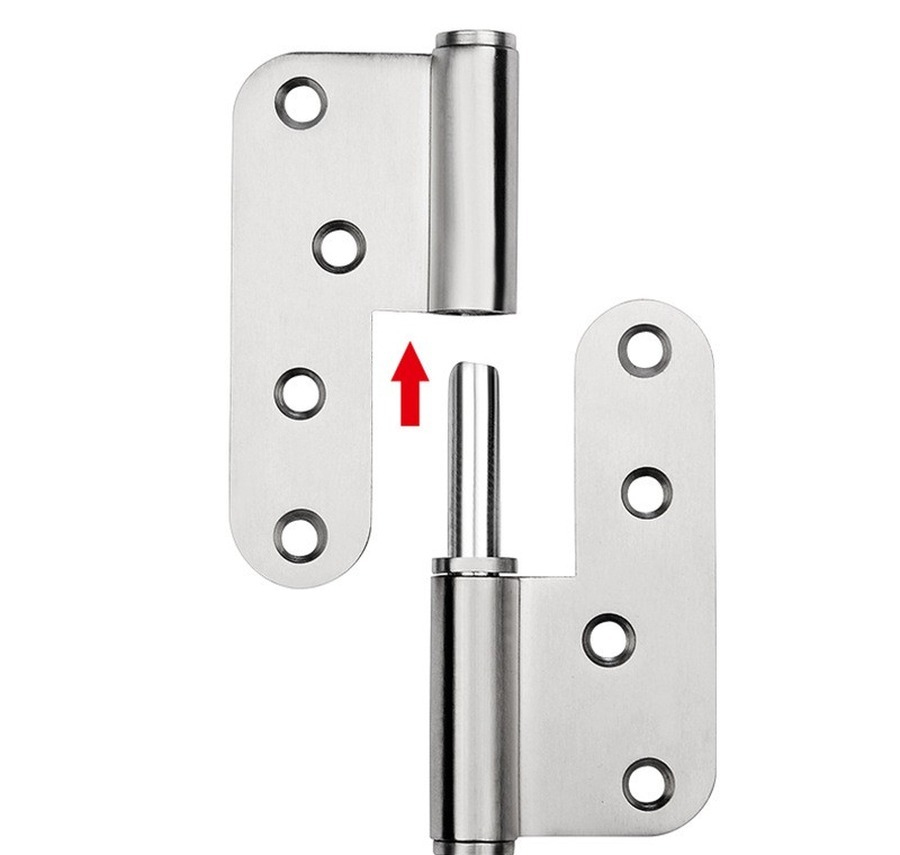
Both patterns are made as a lift-off hinge. The upper knuckle sits over the pin rather than being closed around it, so the whole leaf lifts away — the door comes off the frame without a screwdriver, and goes back on in the same position it left.
That matters more than it sounds. On a wardrobe run it is how you get a door off to move furniture without disturbing the alignment. On a plant room or a service cupboard it is how a leaf comes off for a pump to pass. On a fit-out it is how a damaged leaf is swapped without touching the frame, which is the difference between an hour and a day on a building that is already occupied.
The thick washer under the lower knuckle is what takes the wear in that arrangement — it is the part that carries the leaf every time it is lifted and set back down, and it is why these are not simply a standard hinge with the pin shortened.
The trade-off, stated plainly: a lift-off hinge is not for a security door. Anything that lifts off can be lifted off by someone else, so on an exterior entrance leaf the fixed-pin pattern is the right answer and we will say so if you ask for lift-off on one. For interior joinery, cupboards, service doors and wardrobe runs it is the more practical fitting by a wide margin.
Measured off the production drawing rather than rounded from a catalogue. The L pattern at 100 mm and the H pattern at 140 mm are set out below; the 140 mm L and the 110 mm H are the same two patterns at a different plate length, and their drawing goes out with the quotation.
| Dimension | L pattern — 100 mm | H pattern — 140 mm |
|---|---|---|
| Overall length | 100 mm | 140 mm |
| Overall width, both leaves | 90 mm | 60 mm |
| Leaf width A | 26 mm | 15 mm |
| Leaf width B | 37 mm | 23 mm |
| Knuckle diameter | Ø16 mm | — |
| Knuckle length | — | 94 mm |
| Pin diameter | — | 12.5 mm |
| Hole pitch | 28 / 28 / 27 mm | 38 / 38 / 38 mm |
| Leaf thickness | 3.0 mm nominal (2.9 mm measured) | 3.0 mm nominal (2.9 mm measured) |
| Load | 80 kg per pair | 50 kg per pair |
| Handing | Left / right opening | Left / right opening |
| Fixings | Countersunk screws supplied | Countersunk screws supplied |
Reading the two columns: the L pattern is short and wide — 100 mm of plate carrying 80 kg per pair. The H pattern is long and narrow — 140 mm of plate but only 60 mm across, which is what lets it sit on a narrow stile. Pick by the shape of the frame, then check the load: a pair of H at 50 kg is a cupboard or a light leaf, not an entrance door.
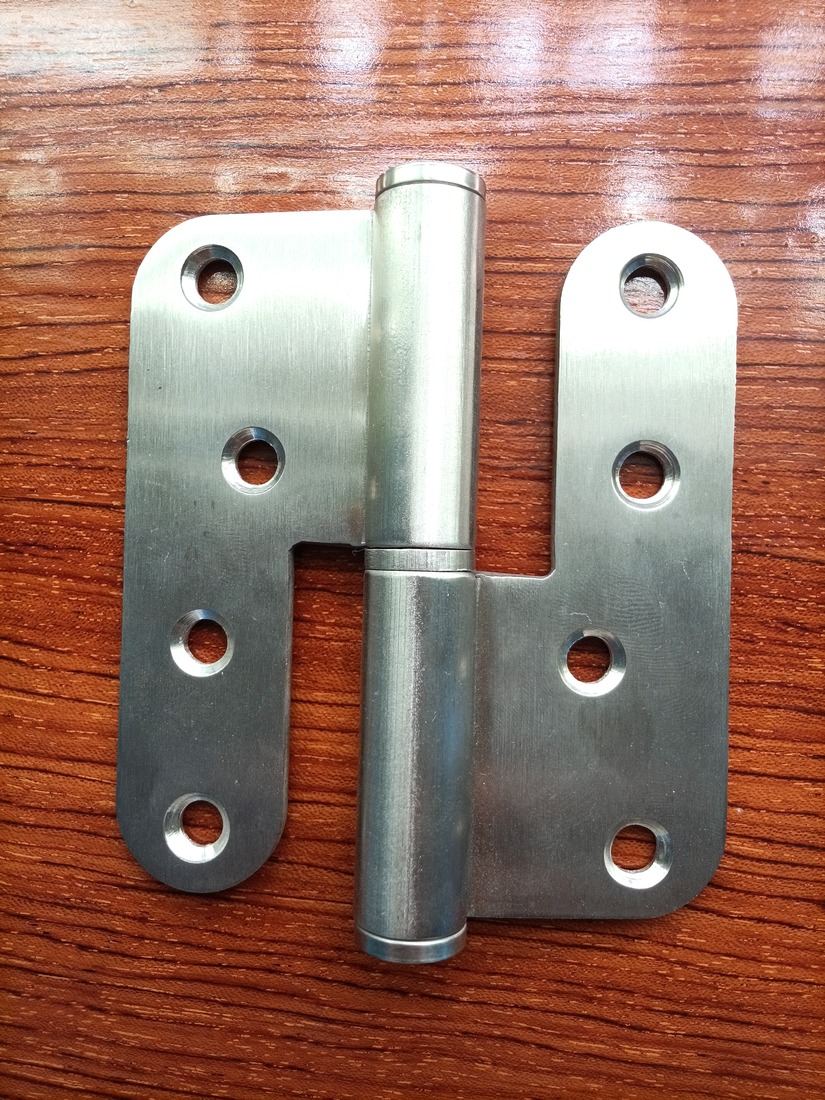
A hinge almost never fails at the pin. It fails at the screw holes: the plate is thin, the load sits on four small countersinks, and over a few thousand cycles the screws work in their holes until the leaf drops a couple of millimetres and the door starts catching the frame.
HY-L is the answer to that specific failure. The leaf is thickened and sits on a reinforced base, so the load is carried over a much larger area of the plate and transferred to the frame through the full length of the screw line rather than at four points. The knuckle is sized to match, because a heavy leaf also bends the barrel over time — and a bent barrel is what makes a grand entrance door feel cheap every time it is opened.
It is catalogued for grand residential work, and that is where most of it goes: a solid timber entrance leaf, an oversized pivot-style door, anything where the joinery is expensive enough that the hardware should not be the weak link. It is also the pattern to reach for on a door that has already failed once — if the last hinge pulled out of the frame, replacing it with the same weight of hinge will produce the same result.
HY-L is the rounded-corner pattern in the standard list — 100 or 140 mm of plate, 90 mm across, rated 80 kg per pair. The eight catalogued combinations are above; a square-corner version exists on the same tooling but is quoted as non-standard.
What we need to quote it: the leaf weight, the leaf thickness, the frame material, and either the hole pattern you already have or a drawing. The 100 mm pattern with its measurements is tabulated below; other lengths are cut to your drawing rather than picked off a list.
Two long plates with the barrel sitting between them, screwed flat to the frame and to the leaf. No mortise, no rebate, no cutting. That is the whole point of an H hinge, and it is why it turns up wherever the door surface and the frame surface are already finished.
The shape does something useful beyond convenience. Because the plates run the full height of the hinge and the screws are spread along them — well away from the pivot — the load is distributed over a long line rather than concentrated at a small knuckle. The further the outermost screw sits from the barrel, the less leverage the leaf has to work it loose. A door that has shaken a mortised hinge out of its frame will often sit quietly on an H pattern.
It is catalogued in premium 304 stainless, which is the right call for the places these end up: wardrobe and cabinet runs in coastal apartments, flush doors in humid climates, exterior-facing cupboard leaves. 201 can be quoted for dry interior work where the budget is the constraint and the environment is not.
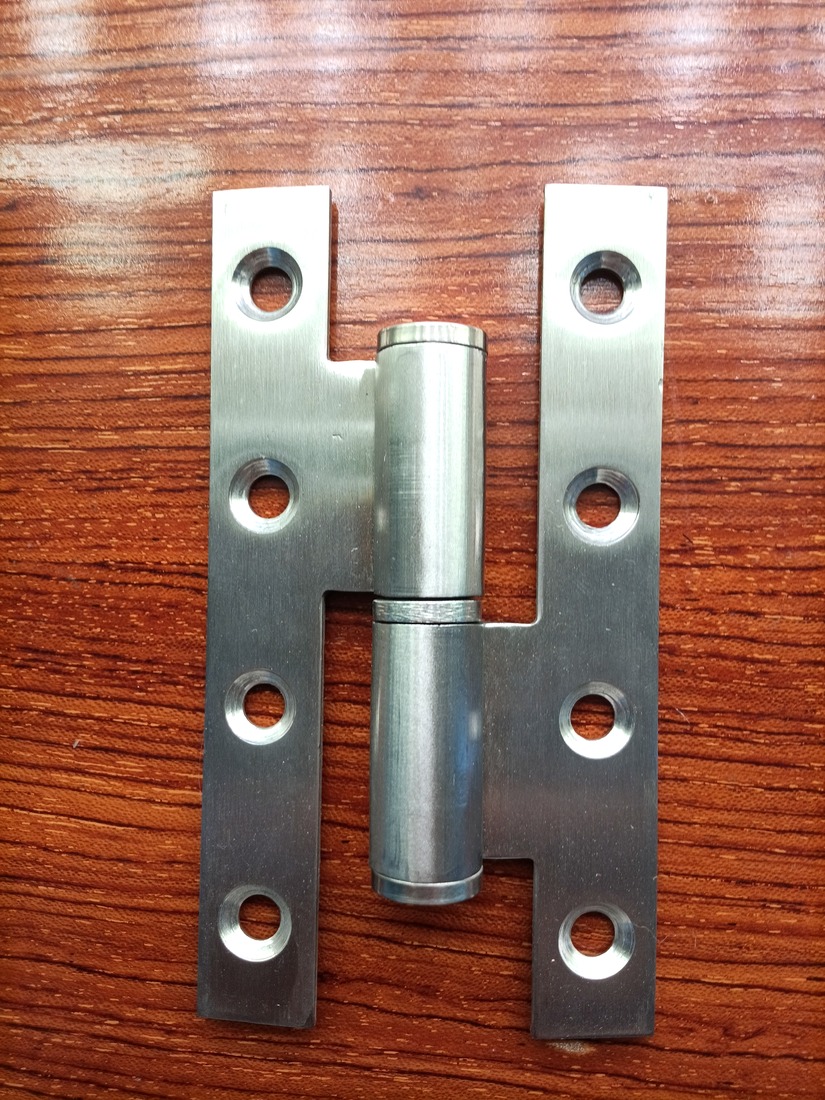
A mortised hinge is installed before the door is finished, because cutting a rebate afterwards means repairing the finish. An H hinge is installed on top of it. On a refurbishment, or on a cabinet that arrives from a joinery shop already lacquered, that difference decides the schedule: the hinge goes on with a screwdriver, the door goes back on, and nothing has to be sent away.
The trade-off is that the hinge is visible. There is no hiding an H plate in a rebate — it is a line of stainless on the face of the door. On a wardrobe or a utility cupboard that reads as intended; on a flush architectural door it has to be a decision the designer has already made. If the drawing calls for concealed, this is the wrong pattern and the 3D adjustable concealed hinge is the conversation.
The two plates have to be flat, parallel and on the same axis as the barrel, or the door binds at one end of the swing and the screws take the difference. That is what the catalogue line means: the plates and barrel are matched in one operation rather than assembled from parts that happened to be in tolerance. On a long plate the error compounds — a plate that is 0.3 mm out at one end is a door that has to be lifted to close.
HY-H is the square-corner pattern in the standard list — 110 or 140 mm of plate, 60 mm across, rated 50 kg per pair. On this pattern the corner is not cosmetic: the plate is fully visible, so it is the part people see and the part that catches on a cloth or a sleeve. Square is also the quicker one to fit: the recess is three straight cuts, with no radius to follow. The eight combinations are listed above, and the measured dimensions are below.
What we need to quote it: leaf length and width, leaf thickness and weight, the hole pattern if one already exists, the corner profile, and the material. H hinges are made to the door rather than picked from stock sizes — the plate length is the variable that has to match your frame.
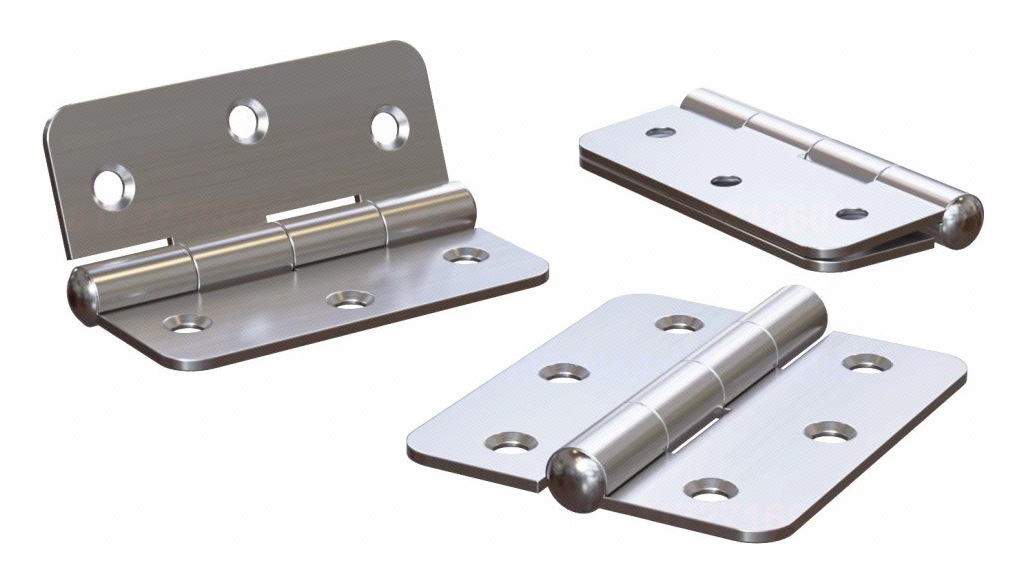
A spring hinge does with a coiled spring what an overhead closer does with a hydraulic arm — and it does it inside the hinge line, where nothing hangs into the doorway. On a utility room, a store cupboard, a garden gate or a corridor door that must not be left open, that is often the only acceptable answer.
Opening the door winds the spring; letting go releases it and the leaf returns. There is no hydraulics, no oil, no arm to be knocked, and nothing to adjust with an Allen key at head height. The trade-off is damping: a spring returns the leaf firmly, and how firmly depends on how much spring is in the hinge and how heavy the door is. That is exactly what the adjustable closing force is for.
Set it too strong and the door slams, which is unpleasant in a house and unacceptable where a child's fingers are at the frame edge. Set it too weak and the door stops short of the latch and stays ajar — which defeats the purpose of fitting it. The adjustment exists so one hinge can cover a band of door weights, and so the installer can tune it on site once the door is actually hung.
Leaf weight and leaf width. Weight decides how much spring you need; width decides how much leverage the leaf has against that spring. A wide, light door can be harder on a spring than a narrow, heavier one, because the handle is further from the pivot. Give us both and we will set the hinge before packing rather than leave the whole range of adjustment for the site to discover.
| Option | Where it wins | Where it loses |
|---|---|---|
| Spring hinge (HY-T) | Nothing in the doorway, nothing on the floor, no arm to damage; fits inside the existing hinge line | No hydraulic damping — the return is firm, and a very heavy leaf needs more spring than a hinge can hold |
| Overhead closer | Damped, adjustable, holds a heavy fire leaf open or closed | Visible arm, needs headroom, gets knocked in a busy corridor |
| Floor spring | Invisible, handles glass and very heavy leaves | Floor box, excavation, and a maintenance item under the floor for the life of the building |
A wound spring stores real energy. The hinge should be adjusted with the door hung and supported, never with the leaf off and the spring under load, and never by backing a pin out to see what happens. If a door has to come off, close it first and take the load off the spring. We ship HY-T with the force set for the door weight you give us, which means the site should be fine-tuning a setting rather than discovering it.
What we need to quote it: leaf weight and width, whether the door has to latch or merely close, the frame material, and the material and finish. Tell us if the door is on a slope or a draft — a door that has to fight air pressure needs more spring than its weight suggests.
This is the question that arrives with a photo attached and no dimensions. In most cases the door itself answers it.
HY-L. Heavy, expensive joinery, opened a few times a day by people who notice how it feels. The thickened plate keeps the screws from working and the heavier knuckle keeps the swing quiet — and on this door those two things are the whole experience.
HY-H. Usually already finished when it reaches site, with no rebate cut. The plates screw flat to the carcass and the leaf, and the hinge is meant to be seen — on a wardrobe that is a detail, not a compromise.
HY-T. A closer would hang into the opening or take headroom that is not there. Set the spring to the leaf and the door returns on its own, every time, without anyone being asked to remember.
Look at where it failed. Screws pulled out of the frame or plate bending near the fixings — HY-L. Hinge shaken loose on a flush frame — HY-H, because the fixings sit further from the pivot. Binding at one end of the swing is not a hinge-size problem at all; it is a frame that is out of square.
None of the three, if the drawing shows no visible hardware. That is the 3D concealed hinge. If a visible plate is acceptable, HY-H in 304 is the practical answer.
HY-H or HY-L in 304, not 201. On a spring hinge the same rule applies — salt air attacks the spring and the pin before it attacks the plate, and that is where the door starts to stick rather than swing.
304 stainless is the catalogued material for HY-H and the sensible default for any of the three in a coastal, humid or wash-down environment. 201 is a real cost saving for dry interior work and a false economy anywhere the door sees salt or regular wet cleaning — it will not fail on the day, it will fail two summers later, and it will look like our fault.
Finishes follow the rest of the range: brushed stainless, gold, black, gun-metal. On these patterns the finish is applied after the plates are formed, so the edges and countersinks carry the same coating as the face — which is what decides whether the hinge still looks right after a year of handling. Colour is quoted per order and checked in process; raw material is bought in one lot so a container matches itself.
None of these three is bought by model number alone. The plate length, the hole centres and — on HY-T — the spring setting all depend on the leaf in front of you.
| Send this | What it decides |
|---|---|
| Leaf weight and thickness | How much hinge you need, and on HY-T how much spring. A weight is better than a guess — a 2.1 m solid core leaf is not the same door as a hollow one of the same size. |
| Leaf width and height | Leverage. A wide leaf loads the hinge harder than a narrow one of the same weight. |
| Plate length and hole pattern | Whether the hinge fits the frame that exists. A photograph with a ruler is enough if there is no drawing. |
| Frame material | Timber, steel-cased or aluminium, which decides the fixing and how the plate has to sit. |
| Material grade | 201 or 304, decided by the environment rather than by the budget alone. |
| Finish and marking | Finish code, plus any brand or part number to be stamped — cut into the same tooling, so it adds no separate production step. |
| Quantity and destination | Trial quantity, port, and whether the goods ship palletised or loose. |
A drawing or a sample arrives, and it gets measured rather than estimated: plate length, plate width, hole centres, knuckle diameter, spring setting. If the sample is an old hinge off the door, that is the best possible input — it already contains every decision the frame made, including the ones nobody wrote down.
Then a sample is made against that measurement and sent for approval. Nothing goes into production until it has been signed off, because on a made-to-door hinge the cost of being two millimetres out is a container that cannot be hung. After approval, production runs, and the same measurements go on the inspection sheet that the batch is checked against before packing.
Tooling for a new plate or a new hole pattern carries its own minimum, quoted per drawing. A change of hole centres and a change of plate length are not the same amount of work, so a published figure would be wrong for one of them — we quote it against the drawing instead.
The fastest way to a price: a photo of the door edge and the frame with a ruler against them, the leaf weight if it is known, and the quantity. That is usually enough to come back with a pattern, a material recommendation and a unit price the same day — and it is more reliable than a specification written from memory.
The pattern decides how the hinge mounts; these five rules decide whether it survives the first year.
On a steel-cased frame, a self-tapping screw will strip the casing on the last turn and the plate will sit proud. Use machine screws or a rivet nut. On timber, a screw that is too long is worse than one that is too short — it splits the stile from the inside and there is no repair for that.
Especially on HY-L, where the plate is thick and the screw has to pull it down flat. A pilot hole sized to the screw's core, not its thread, is the difference between a plate that pulls down evenly and one that rides up on a swelling around the hole.
Set the upper hinge, hang the leaf on it with the lower ones loose, and look at the gap at the lock side before anything else is tightened. Every pattern here shows a frame that is out of square as a bind at one end of the swing — better to find it with two screws in than six.
On HY-T, hang and align the door first, then adjust the closing force. Adjusting before the leaf is seated means adjusting twice, and a spring under load is not something to be experimenting with while the door is half on.
Three on anything tall, heavy or carrying a closer — the third hinge is not there for extra capacity, it is there so the top hinge is not carrying the whole leaf on its own. On a spring set, keep the springs matched: one strong hinge and one weak one fights itself and the door hangs crooked.
Twenty full cycles. A bind, a click, or a leaf that drifts is an installation fault at this stage and a warranty argument later. Fix it while the tools are still out.
HY-L is an industrial heavy-duty hinge on a thickened reinforced base, for a leaf that is simply heavy. HY-H is an H pattern — two long plates with the barrel between them — screwed flat to a frame with no rebate, spreading the load along the plate. HY-T is a spring hinge that closes the door itself, with adjustable closing force.
In the standard list the two travel together: rounded corner on the L pattern, square corner on the H pattern. Square is the easy one to fit — straight cuts, square corners, and it still sits on a frame that is not perfectly true. Rounded looks better: a softer line, nothing to chip at the corner, and nothing to catch a sleeve — but the opening has to follow the radius, which is the extra work on site. Rounded on an H plate, or square on an L, can be made on the same tooling but is quoted as non-standard.
The eight lines are: L at 100 and 140 mm, H at 110 and 140 mm, each in a left- and a right-opening version. State the handing — the plate is not symmetrical, so a left cannot be turned into a right. If it is not obvious from the drawing, send a photo of the door edge with the old hinge in place.
Yes — the two patterns we run most are tabulated on this page: L pattern at 100 mm (90 mm across, 26/37 mm leaves, 3.0 mm leaf, 80 kg per pair) and H pattern at 140 mm (60 mm across, 15/23 mm leaves, 3.0 mm leaf, 50 kg per pair). Both are 3.0 mm nominal, 2.9 mm measured. Other lengths and hole patterns are made to the door — send a drawing or a sample and we measure it. If a customer repeats the same hinge we keep the measurements on file, so the second order matches the first.
HY-L, unless the frame has no rebate and a visible plate is acceptable — in which case HY-H does the job with its fixings further from the pivot. What we need either way is the leaf weight and thickness, because "heavy" to one joiner is a standard door to another.
Both. The pattern scales: the same H geometry that holds a wardrobe leaf will hold a flush door, because the load path is the plate length and the screw spacing rather than the knuckle. Send the leaf weight and we will size the plate to it.
It depends on the leaf, not on the hinge alone — weight and width both matter, and a wide light door is harder on a spring than a narrow heavy one. Tell us both and we set the force before packing. A door that has to fight a draft or sit on a slope needs more spring than its weight suggests.
Yes — both patterns are made as a lift-off hinge. The upper knuckle sits over the pin instead of being closed around it, so a leaf comes off the frame without unscrewing anything and goes back in the same position. It is how a wardrobe door comes off for furniture to pass, or a damaged leaf is swapped without touching the frame.
The exception is a security or entrance door: anything that lifts off can be lifted off by someone else, so we recommend the fixed-pin pattern there.
Yes, that is what the adjustment is for: we set it for the door you describe, and the installer fine-tunes it once the leaf is hung. Adjust it with the door on and supported, never with the leaf off and the spring wound up.
304 for anything coastal, humid, exterior-facing or regularly washed. 201 for dry interior work where the saving matters and the environment will not punish it. On a spring hinge, check the grade carefully — the spring and pin are where corrosion starts, and that is the part that makes the door stick.
Yes — brushed stainless, gold, black and gun-metal, applied after forming so the edges and countersinks carry the same finish as the face. Colour is quoted per order and raw material is bought in one lot, so a container matches itself; matching an installation from two years ago needs a sample check.
Yes, brand or part number, cut into the same tooling — no separate production step, so no separate charge. Send the artwork with the order.
2,000 pcs for a trial order and 20,000 pcs for bulk pricing, counted per item — patterns, sizes and finishes can be mixed inside one order. A new plate or hole pattern carries its own tooling minimum, quoted against the drawing.
30–35 days after deposit and sample approval. T/T 30 % deposit and 70 % against the B/L copy, with a 40 % deposit on your first three orders and 30 % from the fourth. Samples are free; you cover the freight.
Not in our own name. The oil-free series is produced for a European customer to their CE-marked EN 1935 Grade 14 specification, and that marking belongs to the brand owner; see the oil-free page for how that arrangement works. If your project needs a certified hinge, tell us at quotation stage and we will say what applies to the pattern you are buying.
A photo of the door edge and the frame with a ruler against them, the leaf weight if you know it, and the quantity. That is enough to come back with a pattern, a material and a price — usually the same day. If it is a repeat of something we made before, quote the old order number and we will pull the drawing.
The same commercial terms apply across our hinges. Full detail, including the sample and inspection steps, is on how ordering works.
2,000 pcs trial, 20,000 pcs bulk. Counted per item — models, sizes and finishes can be mixed in one order.
T/T 30 % deposit and 70 % against the B/L copy. 40 % deposit for your first three orders, 30 % from the fourth.
Free of charge; you pay the freight. Send your courier account or we quote it.
30–35 days after the deposit and sample approval.
EXW, FOB and FCA — FOB Nansha Port, Guangzhou.
White box, two hinges, each in its own bag. The box prints to your artwork and part numbers.
Raw material bought in one lot per order, colour checked in process, out-of-tolerance units scrapped rather than shipped.
Load plan, carton count and gross weight are calculated per order — palletised or loose, depending on the destination.
Carton counts and weights are not fixed figures. Some destinations take cartons loose and carry more pieces in the same container; others require heat-treated timber under ISPM 15, and some customers want no timber at all. Send the model, size, finish, quantity and destination port, and your account manager will work the load plan out for that case before you commit.