Home / Products / Drawer slides
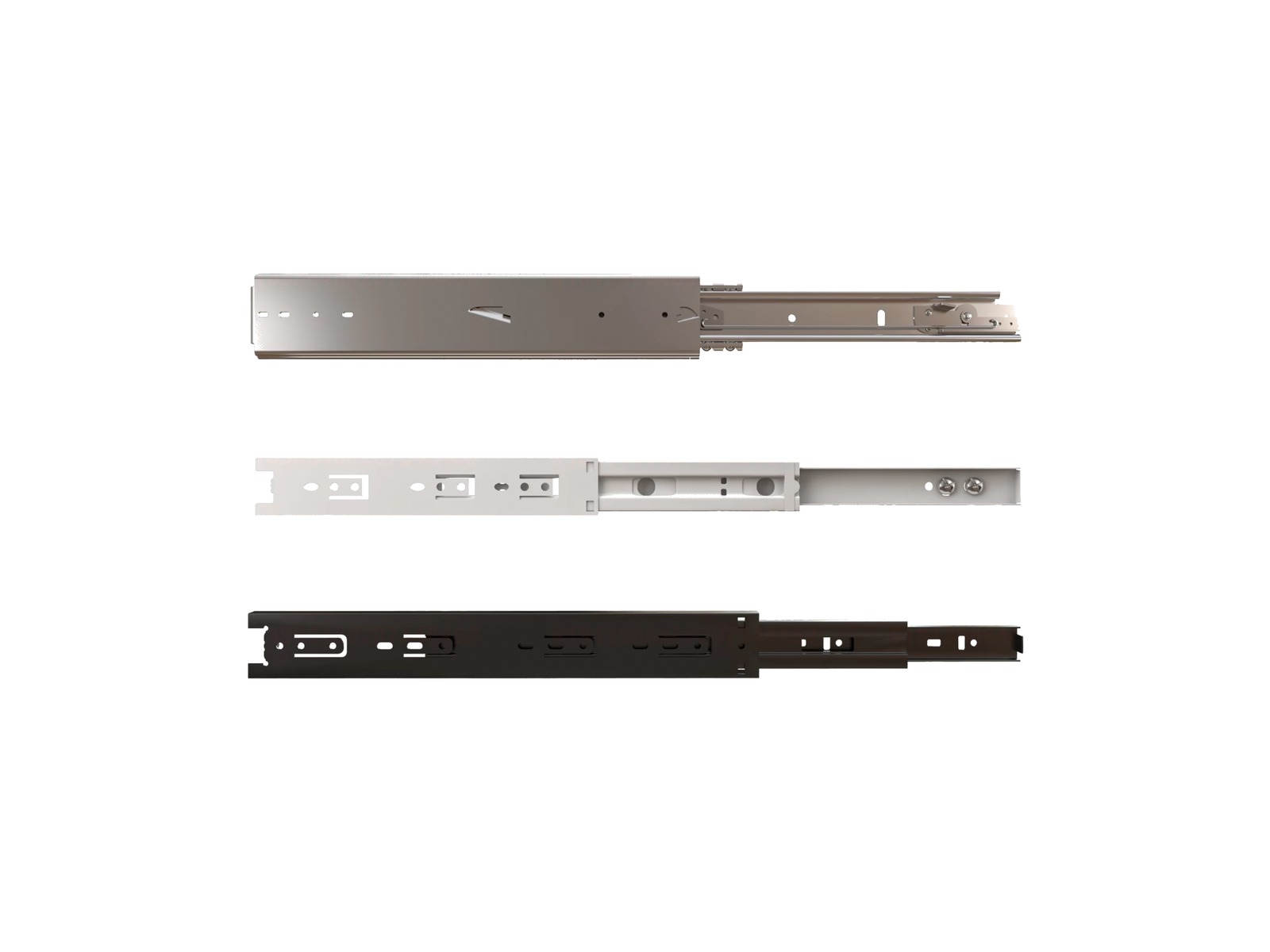
Three sections, not two. The drawer box comes all the way out of the carcass, so you can reach the back of a 600 mm drawer instead of feeling for it. Twelve lengths between 100 and 600 mm in a 43 × 13 mm body of 0.9 mm cold-rolled steel — zinc white or black, free-running or single-spring damped, side or bottom mount, sold by the pair.
The most common mistake in this category is not the brand or the finish — it is ordering a two-section slide when the drawer has to open past three-quarters. A two-section rail leaves the back third of the box inside the cabinet; on a kitchen run that is the difference between a drawer you can use and one you empty with your hand. Everything on this page is three-section, and the numbers below are the ones that decide whether the drawer actually opens: length, section, steel, and what the pair weighs.
A three-section slide is three steel channels that telescope: the outer member screws to the cabinet side, the inner member screws to the drawer box, and a middle member runs between them. At full extension the inner and middle members have both travelled forward, so the back of the drawer box clears the cabinet front.
The middle member is the part worth understanding. At full extension it is carrying the drawer on its own, cantilevered out of the cabinet — which is why a cheap rail is not stiff at the front where you check it, but at two-thirds travel, where the box starts to dip as you push down on the front edge. Steel thickness and the depth of the fold decide that; the label does not.
Balls run in a cage between the members. The cage keeps them spaced and stops them bunching at one end of the travel — the gritty catch you feel halfway out. On the inner member there is a release lever: press it and the drawer lifts off the rail. Pull a drawer out without pressing it and you will bend the cage, not the drawer.
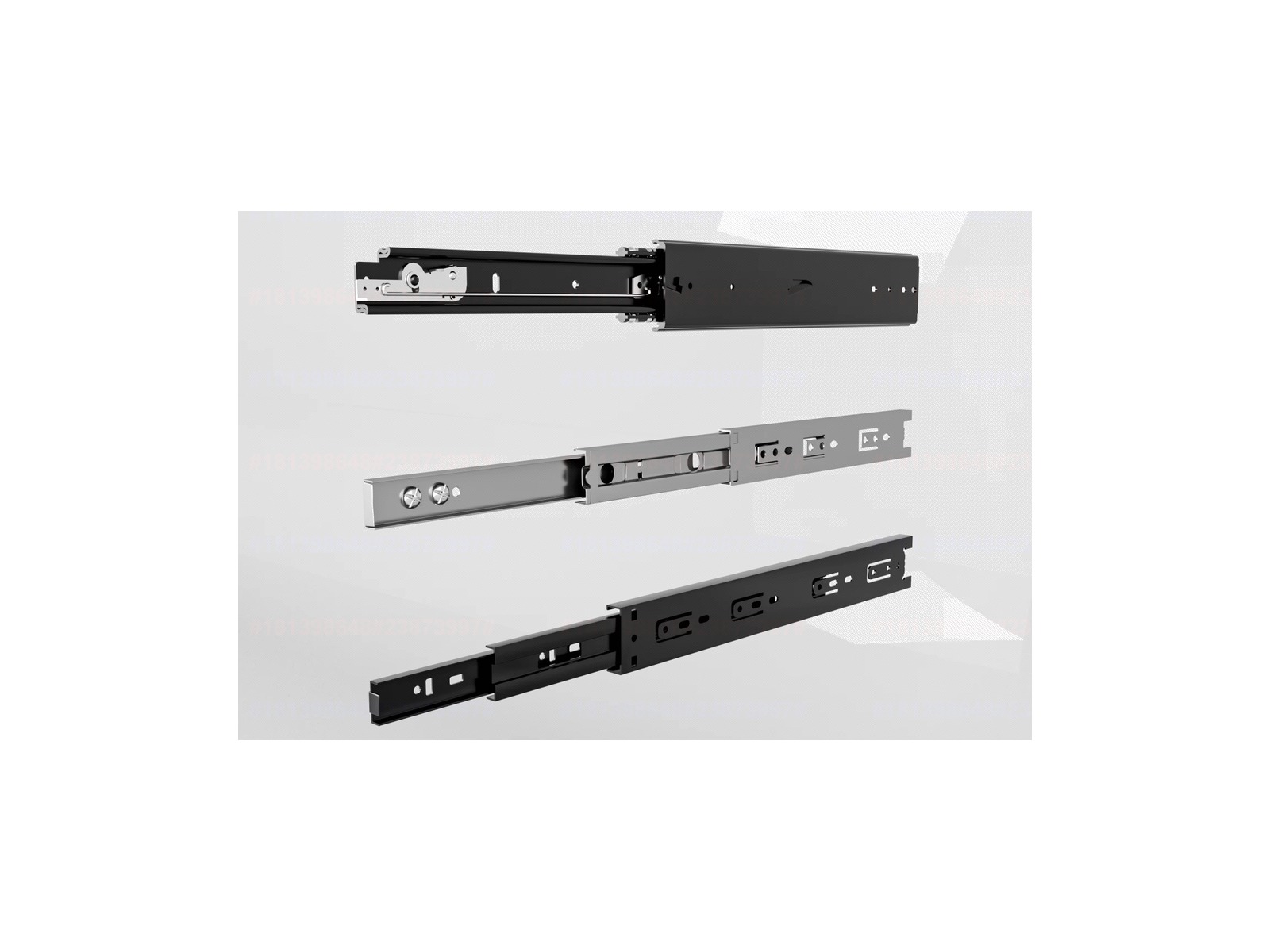
| Check | This series | What a cheaper rail does instead |
|---|---|---|
| Members | Three, full extension | Two members, or three with a shortened middle member — the drawer stops short of the carcass face |
| Steel | 0.9 mm on each of the three members | Thinner steel, or the full section on the outer member only — the one a buyer is most likely to measure |
| Ball cage | Caged, full travel | Loose balls, or a cage that only covers the middle of the travel |
| Release | Lever on the inner member | None — the drawer is levered off, and the cage takes the damage |
| Pair weight | 432 g at 200 mm, 1,296 g at 600 mm | Anything materially lighter at the same length is thinner steel or a shorter member — see the table of weights |
The inch figure in a rail name is a trade label, not a dimension. A 10-inch 4510 is 250 mm; a 10-inch rail from the 40 mm series is 225 mm. Both are sold as “10 inch”. If you are replacing a rail, measure the old one and order the length in millimetres — it is the only figure that is consistent across the two series, and the only one that will not put a 25 mm gap in a drawer front.
| Nominal | Length | Pair weight, silent | Pair weight, damped | Finish |
|---|---|---|---|---|
| 4 in | 100 mm | 192 g | — | Black |
| 5 in | 125 mm | 240 g | — | Black |
| 6 in | 150 mm | 288 g | — | Black |
| 8 in | 200 mm | 432 g | 500 g | White zinc, black |
| 10 in | 250 mm | 540 g | 550 g | White zinc, black |
| 12 in | 300 mm | 648 g | 600 g | White zinc, black |
| 14 in | 350 mm | 756 g | 700 g | White zinc, black |
| 16 in | 400 mm | 864 g | 800 g | White zinc, black |
| 18 in | 450 mm | 972 g | 900 g | White zinc, black |
| 20 in | 500 mm | 1,080 g | 1,000 g | White zinc, black |
| 22 in | 550 mm | 1,188 g | — | White zinc, black |
| 24 in | 600 mm | 1,296 g | — | Black |
| Nominal | Length | Body | Pair weight | Finish |
|---|---|---|---|---|
| 10 in | 225 mm | 38 × 12.5 mm | 330 g | White zinc, black |
| 12 in | 275 mm | 38 × 12.5 mm | 396 g | White zinc, black |
| 14 in | 325 mm | 38 × 12.5 mm | 462 g | White zinc, black |
| 16 in | 375 mm | 38 × 12.5 mm | 528 g | White zinc, black |
| 18 in | 425 mm | 38 × 12.5 mm | 594 g | White zinc, black |
| 20 in | 475 mm | 38 × 12.5 mm | 660 g | White zinc, black |
Lengths step in 25 mm from 200 mm up on the 4510 (100, 125 and 150 mm sit below that), and in 50 mm on the 40 mm series. The two ranges do not overlap: the 4510 starts at 100 mm, the 40 mm series starts at 225 mm. If the length you need is not in either table, say what it is — a cut length is a tooling question, not a catalogue question.
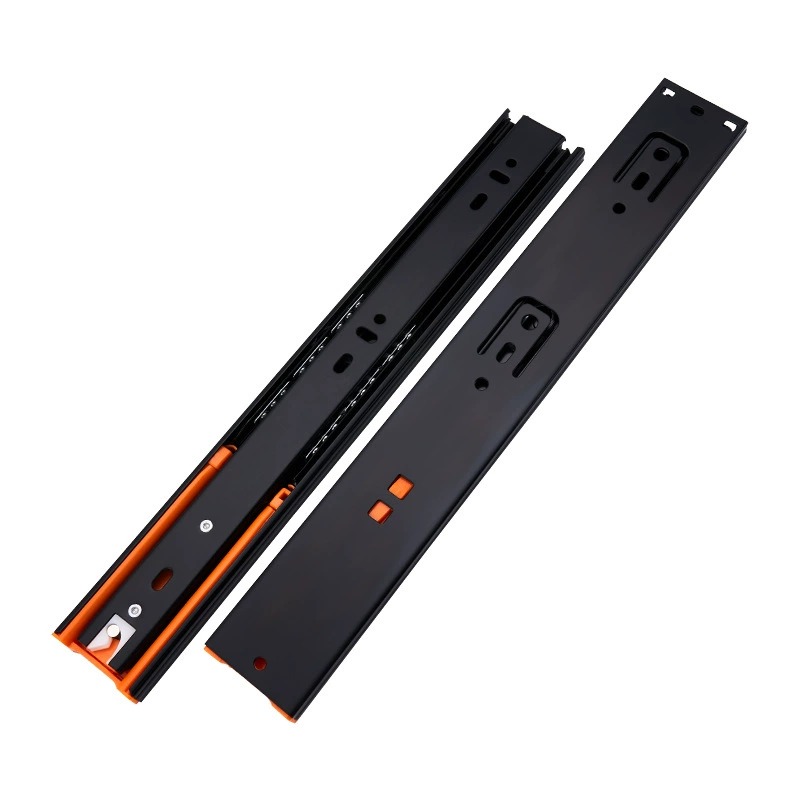
Free-running (the silent version). No spring, no damper — a plain caged ball slide. Push the drawer and it keeps going until it stops; pull and it comes. Nothing to wear out except the cage, and nothing to feel through the drawer front. Most of what we ship to workshops, equipment makers and shop fitters is this one.
Damped (single spring and damper). A single spring pulls the drawer through the last part of the travel and a damper takes the impact at the end, so the drawer closes itself and lands soft instead of hitting the carcass. The spring is what closes it; the damper is what stops it banging. A spring with the damper left out pulls the drawer in and then lets it hit anyway, which is the version worth avoiding.
The case for paying for it is not the kitchen — it is any drawer a hand reaches into without looking. Bedside tables, bathroom units, a TV cabinet in a dark room, a bedroom wardrobe at six in the morning. The case against is a workshop drawer that gets opened forty times a shift: the spring adds a pull you have to work against every time, and nobody needs a soft close on a tool drawer.
| Drawer | Order |
|---|---|
| Bedside table, bathroom vanity, TV unit | Damped, 4510. The self-close is the feature the end user notices first, and the one a showroom sells on |
| Wardrobe, dresser, general furniture | Either. Free-running if the drawer is deep and gets loaded, damped if it is shallow and gets pulled hard |
| Kitchen base unit | Damped if the drawer front is a single panel with no handle; free-running is normal under a handle |
| Display cabinet, small drawer under 250 mm | 40 mm general series — lighter body, shorter lengths, cheaper, and a 43 mm body looks heavy on a jewellery drawer |
| Equipment drawer, workshop, tool cabinet | Free-running, 4510. No spring to fight, nothing to fail in a cold workshop |
Side clearance. The body is 13 mm thick, so plan 13 mm per side between the drawer box and the carcass, and a box about 26 mm narrower than the opening for the 4510 (25 mm for the 40 mm series, which is 12.5 mm thick). If the opening is fixed and the box is not built yet, work from the opening; if the box already exists, send its width and we will tell you which series fits rather than the other way round.
Side mount or bottom mount. The same rail does both. Side mount is normal furniture: outer member on the carcass side, inner on the box side, rail parallel to the drawer bottom. Bottom mount is for boxes with no usable side — a wire basket, a pull-out in a narrow gap, a drawer with a rebated side — where the rail is screwed under the base instead. Either way the two rails must be level with each other and the box square; a 1 mm twist does not show at the front, it shows as a stiff last 100 mm of travel.
Screws are not in the box. This series ships without fixing screws unless you ask for them. Standard wood screws we can add; anything special — machine screws, a particular head, a specific length for a 25 mm panel — is quicker for you to source locally than for us to ship. Say on the order if you want the standard set included, and say it per order, not per shipment.
The lever. Press the release lever on the inner member before lifting a drawer out. It is a small plastic tab at the front of the inner channel and it is the one part of the system that is routinely broken by people who do not know it exists — a bent cage from levering a drawer off is not a warranty item.
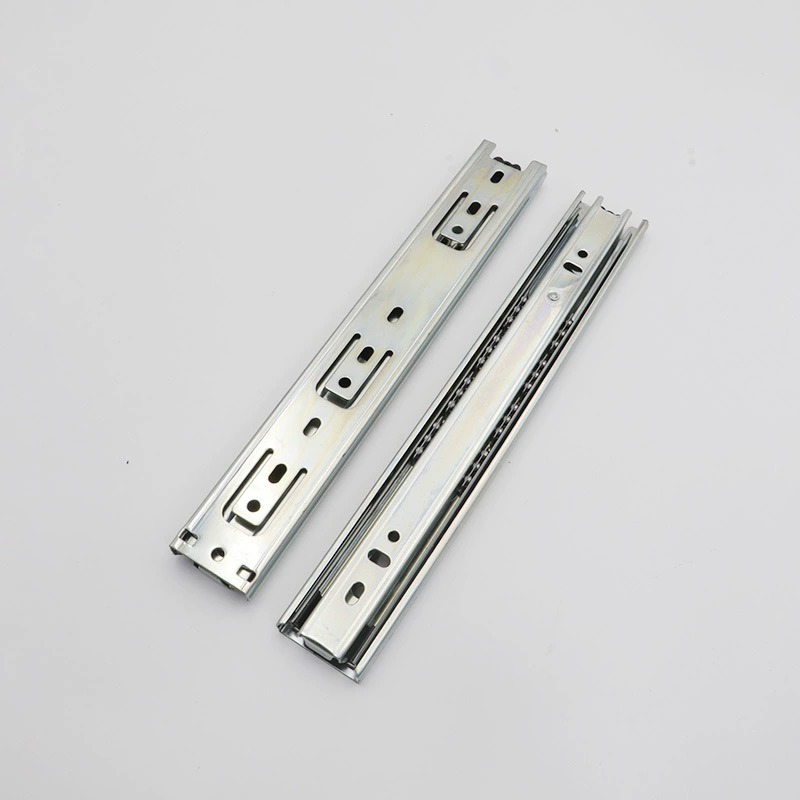
| Finish | What it is | Use it for |
|---|---|---|
| White zinc | Electroplated zinc, bright — a pale blue-white, not a painted white | Light interiors: birch ply, white and pale melamine, flat-pack furniture, anything where a black line behind the drawer front reads as a mistake |
| Black | Zinc plated, then black-finished, so the colour sits in the plating rather than in a paint film over it | Dark carcasses, steel and aluminium cabinets, equipment drawers, and any open shelving where the rail is on show |
Both are plated rather than coated, which matters at the cut edges and around the screw holes: a painted rail wears through where the screw head bites and rusts from that point outwards. Plating does not have that failure, though it will still mark in a wet room — this is a zinc coating on cold-rolled steel, not a stainless rail.
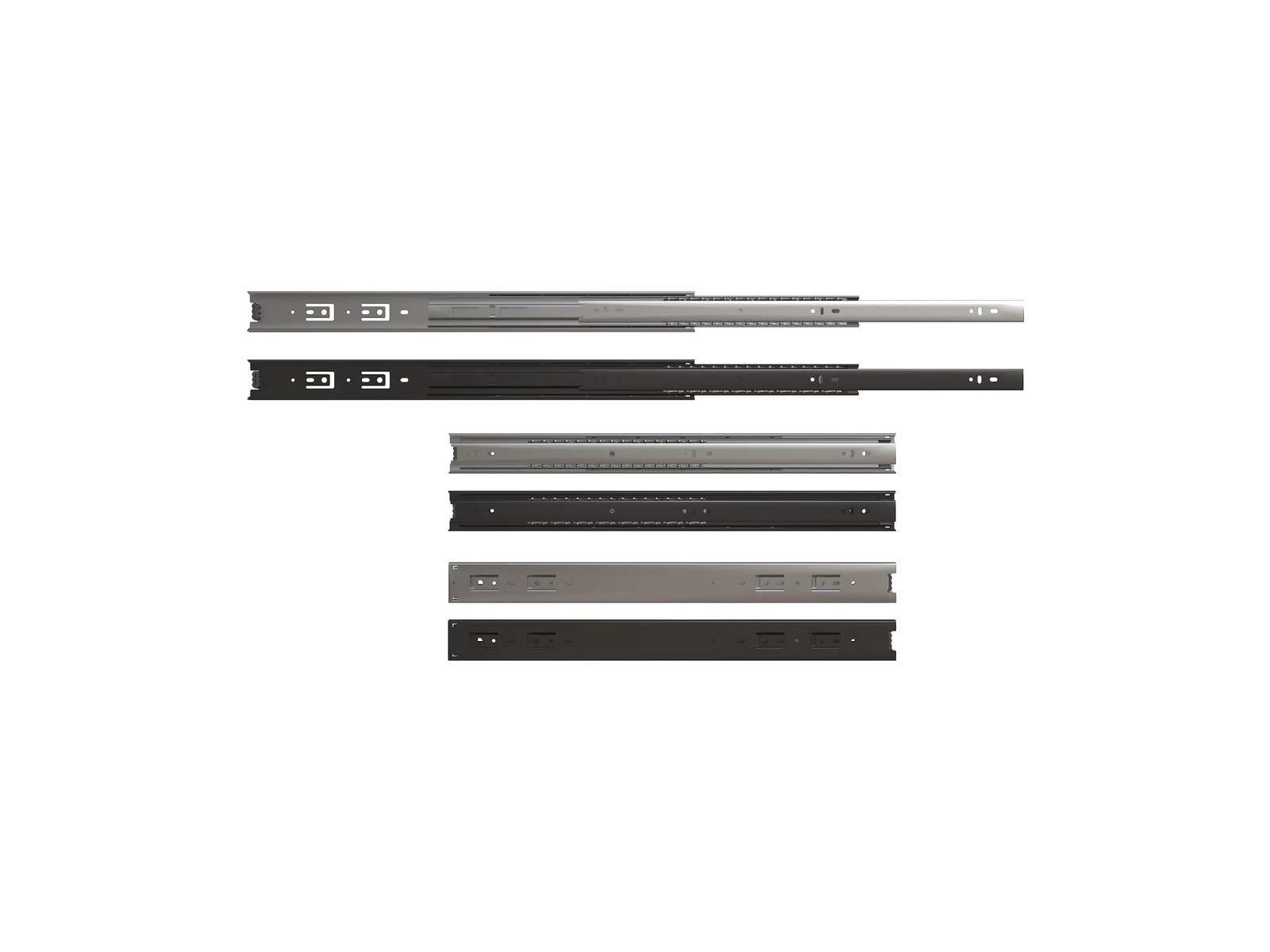
| Item | Detail |
|---|---|
| Unit | One pair (two rails) per box, each rail in its own bag, screws separate when ordered |
| Pair weight | 192 g at 100 mm rising to 1,296 g at 600 mm on the 4510 — full table above |
| Carton | Counts and gross weight are calculated per order by length mix; the carton is sized to the longest rail in it, so a mixed order is packed in length groups |
| Damper colour | The damper body is stocked in whatever colour the batch comes in, and that can change between runs — it is inside the cabinet and not normally specified. If the colour matters for a sample or a showroom unit, say so before the run |
| Marking | The box prints to your artwork and part numbers. The rail is a folded section with no flat panel, so a rail-level mark is limited — send the artwork and we will say what will read at that size |
A drawer slide cannot be inspected by looking at it. Plated, folded steel looks the same at 0.7 mm as at 0.9 mm, and a shortened middle member looks the same until the drawer is fully out. What does not look the same is the weight, and a kitchen scale settles it in ten seconds.
The table above is exactly linear on the 4510: 2.16 g per millimetre of pair length from 200 mm to 600 mm, which is what you would expect from three members of constant section. Below 200 mm it runs at 1.92 g/mm, because the end fittings and the cage do not shrink with the rail. The 40 mm series runs 1.39–1.47 g/mm.
So: weigh a pair, divide by the length you ordered, and compare. A 600 mm 4510 pair should be within a few grams of 1,296 g. If a pallet arrives at 1,050 g for the same length, the difference is not the plating — it is steel or travel, and both of those are the reason a rail fails at two years instead of ten. Weigh it before it goes on the line, not after it comes back.
Same method for the length itself: measure the outer member end to end with a tape, in millimetres. If it reads 225 and the box says 10 inch, it is the 40 mm series, not the 4510 — see the note on the size tables.
| Item | Detail |
|---|---|
| MOQ | 1,000 pairs for a trial order; 10,000 pairs per size for bulk |
| Lengths | 100, 125, 150 mm, then 200–600 mm in 25 mm steps on the 4510; 225–475 mm in 50 mm steps on the 40 mm series |
| Finishes | White zinc, black |
| Action | Free-running as standard; single-spring damped in black from 200 mm to 500 mm |
| Mounting | Side or bottom, same rail |
| Screws | Not included unless ordered — standard wood screws can be added |
| Lead time | 30–35 days after deposit and sample approval |
| Trade terms | EXW, FOB and FCA — FOB Nansha Port, Guangzhou |
What to send with an enquiry. The length in millimetres, how many drawers of each, the finish, free-running or damped, and whether it is side or bottom mount. If you are matching an existing box, send its width as well — that is the one dimension that turns a standard order into a return, and it costs one line in the email to avoid.
Three steel members that telescope, so the drawer box can be pulled clear of the cabinet front — full extension. A two-section slide stops at roughly three-quarters, which leaves the back of the box inside the carcass. On a 500 mm drawer that is 125 mm you cannot reach without taking the drawer out.
Match the rail to the drawer box: a 550 mm box takes the 550 mm rail. The rail also has to fit the interior depth of the carcass — it mounts flat against the side, so a rail longer than the interior leaves the box standing proud of the cabinet front. If you are replacing a rail, measure the old one end to end in millimetres rather than reading the inch label off the box.
No, and this is the mistake worth avoiding. In the 4510 series 10 inch is 250 mm. In the 40 mm general series 10 inch is 225 mm. Both are ordered and invoiced as “10 inch”. Order in millimetres and the ambiguity disappears.
The body: 43 × 13 mm against 38 × 12.5 mm. The length scale: 100–600 mm in a mix of 25 and 50 mm steps against 225–475 mm in 50 mm steps. The 40 mm series is for small drawers — bedside tables, display cabinets, jewellery drawers — where a 43 mm body looks and feels oversized.
Damped for anything a hand reaches into without looking: bedside, bathroom, TV unit, bedroom wardrobe. Free-running for workshop and equipment drawers, and for kitchen drawers under a handle, where the spring just adds resistance every time the drawer is opened. The damped version is the more expensive of the two, and it is worth it in the rooms where a drawer closing quietly is the point.
In this range the damped version runs in black, from 200 mm to 500 mm; white zinc is made free-running. White damped is a question of run size rather than of design — ask with the quantity and we will tell you whether it can be scheduled.
We do not publish a kg rating for this series, because a rating without the test behind it is a number in a brochure. What decides it in practice is the length — a 600 mm rail carries less than a 300 mm one at the same steel — how many rails a drawer has, and whether the load sits at the front or the back. Tell us the drawer width and what goes in it and we will tell you whether this body is right or whether you need to go up a size.
Not unless you ask. Standard wood screws can be added; special screws — machine thread, a particular head, a length for a 25 mm panel — are usually faster to source locally than to ship. Say it on the order rather than assuming it is in the carton, because it is not.
Side mount is the normal case: outer member on the carcass side, inner member on the drawer box side. Bottom mount is for boxes with no usable side — wire baskets, pull-outs in a narrow gap, drawers with a rebated side — where the rail is fixed under the base. It is the same rail; only the brackets and the fitting position change.
Usually, but send the box width and depth before ordering. The body is 13 mm thick, so the box needs about 26 mm of clearance against the opening on the 4510 (25 mm on the 40 mm series). A box built for a different rail can be a few millimetres out in either direction, and that is not something that can be corrected at the bench.
1,000 pairs for a trial order, and 10,000 pairs per size for bulk, with lengths and finishes mixed inside one order. Lead time is 30–35 days after deposit and sample approval.
Yes — the box prints to your artwork and part numbers. The rail itself is a folded section with no flat panel, so a rail-level mark is limited to a stamp on the outer member where the run is large enough. Send the artwork with the order; the box is printed before the rails are packed.
Ask. A length that is not in the table is a tooling question, and the answer depends on the size. On the heavier build: if a drawer needs more than a 0.9 mm section carries, we will say so rather than relabel the same rail as heavy duty — that is what the load question above is for.
The same commercial terms apply across our drawer slides. Full detail, including the sample and inspection steps, is on how ordering works.
1,000 pairs trial, 10,000 pairs per size for bulk. Lengths and finishes can be mixed in one order.
T/T 30 % deposit and 70 % against the B/L copy. 40 % deposit for your first three orders, 30 % from the fourth.
Free of charge; you pay the freight. Send your courier account or we quote it.
30–35 days after the deposit and sample approval.
EXW, FOB and FCA — FOB Nansha Port, Guangzhou.
One pair per box, each rail in its own bag. The box prints to your artwork and part numbers.
Raw material bought in one lot per order, colour checked in process, out-of-tolerance units scrapped rather than shipped.
Load plan, carton count and gross weight are calculated per order — palletised or loose, depending on the destination.
Carton counts and weights are not fixed figures. Some destinations take cartons loose and carry more pieces in the same container; others require heat-treated timber under ISPM 15, and some customers want no timber at all. Send the model, size, finish, quantity and destination port, and your account manager will work the load plan out for that case before you commit.