Home / Products / Oiled & oil-free hinges
One heavy-duty stainless hinge, built two ways — with damping grease in the knuckle, or with nothing in it at all. 160 kg per pair, 200,000+ cycles, 3.0 mm leaf, four finishes, six sizes. This range has run on EU orders, manufactured to a customer’s CE-marked EN 1935 Grade 14 specification.
 How that works →
A conventional hinge carries grease in the knuckle and nobody thinks about it — until the grease migrates, dust binds to what is left, and a door in a hospital corridor starts to drag three years later. The usual answer is an oil hole and a maintenance schedule that never happens on a building with two hundred doors.
This range is the same hinge built either way, decided by one line on the purchase order. Oiled: damping grease is packed into the knuckle, which lubricates the movement and damps it — the leaf settles into the frame instead of arriving there, smoother through the swing and quieter at the close. Oil-free: no grease at all, and the leaf turns on a stack of hardened washers, so there is nothing to migrate, nothing to stain a pale door, and nothing for dust to bind to.
What does not change between the two is the part that carries the load: a 3.0 mm leaf, a Ø14 knuckle, hardened washers, and a 160 kg rating per pair. The fill decides how the door feels in the hand and how the building has to be run. The leaf and the hinge count decide what the door will actually hold — and no amount of grease has ever added a kilogram to that figure.
The range is catalogued as two patterns because that is how a joiner orders it — by what the frame looks like, not by what is inside the knuckle. Inside, they are the same hinge.
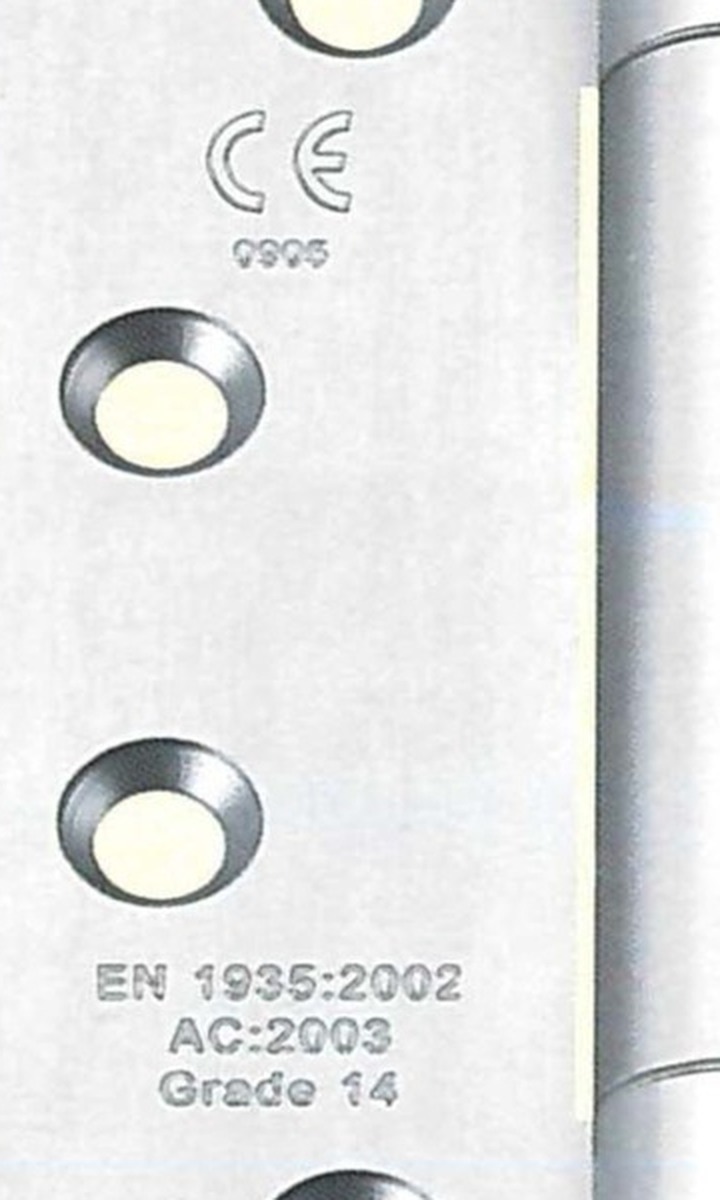
The flat leaf pattern with the rectangular aperture in one plate. It is the pattern most timber doors are already cut for, which makes it the default choice on a replacement order: the existing mortise is reused, the door does not come off site, and a building can be re-hung one leaf at a time.
Because the leaf sits into a shallow rebate rather than a deep one, it suits door blanks in the 35–45 mm band and it is the pattern we ship most often in gold, black and gun-metal for interior joinery. The plate carries the full washer stack, so the load figure does not change with the pattern — both are rated the same.

The square-edge butt pattern, with the knuckle proud of the leaf line. It is the one to specify when the frame is steel-cased, when the door is being hung into a prepared lining, or when the architect has drawn a full-leaf hinge and a site inspector will hold the door to that drawing.
In gun-metal it is also the pattern that survives coastal and industrial interiors without showing every fingerprint, which is why the same hinge keeps turning up on hotel corridor doors and plant-room doors in the same building. Both patterns take the same six sizes, the same four finishes and the same fixing centres within a size.
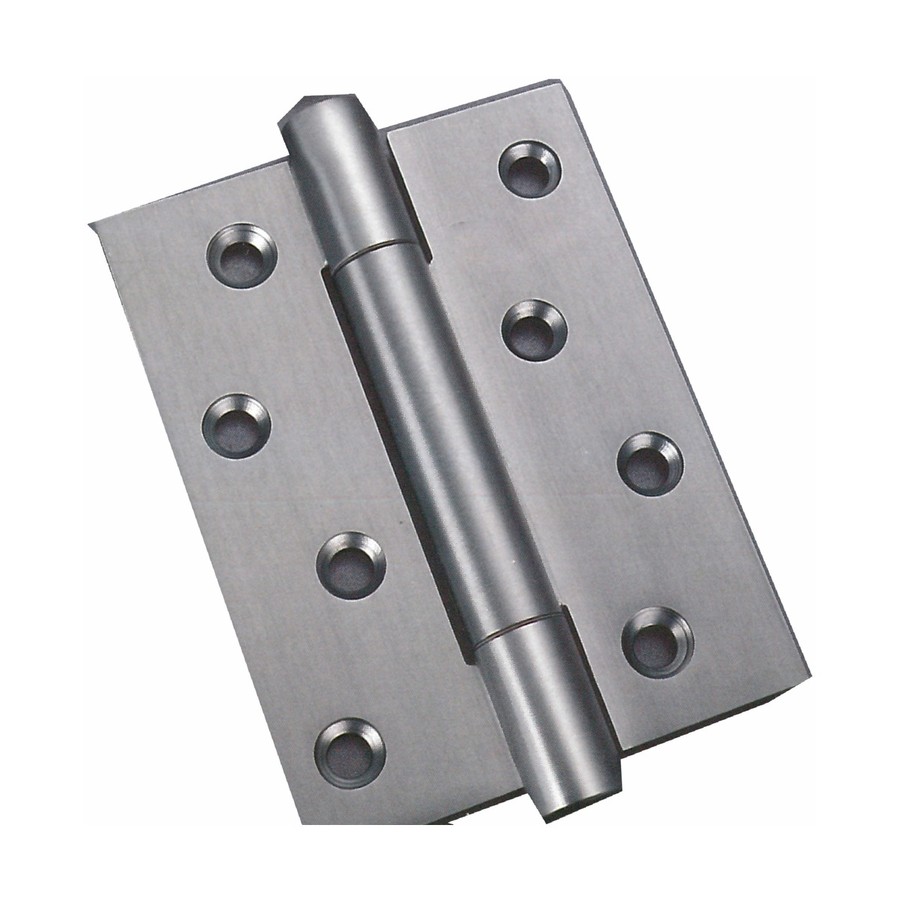
What the two patterns share: the hardened washer stack, a 3.0 mm leaf, a Ø14 knuckle, 201 or 304 stainless, four finishes — and the grease fill, oiled or dry, which is a line on the order rather than a difference between the patterns. What changes between them is the shape of the plate and where the screw holes fall — nothing that touches the load path. If you are replacing hinges on an existing door, photograph the old plate against a ruler and send it; we will match the pattern and the hole centres rather than ask you to re-drill.
Everything below is the catalogue table, with the columns opened out so each number can be checked on its own. All six models share the same leaf thickness, knuckle diameter, material options and load rating.
| Model | Material | Knuckle | Leaf height | Leaf width | Leaf thickness | Load / pair |
|---|---|---|---|---|---|---|
| HY-433 | SS304 / SS201 | Ø14 | 4″ | 3″ | 3.0 mm | 160 kg |
| HY-4353 | SS304 / SS201 | Ø14 | 4″ | 3.5″ | 3.0 mm | 160 kg |
| HY-4353 | SS304 / SS201 | Ø14 | 4″ | 4″ | 3.0 mm | 160 kg |
| HY-4543 | SS304 / SS201 | Ø14 | 4.5″ | 4″ | 3.0 mm | 160 kg |
| HY-533 | SS304 / SS201 | Ø14 | 5″ | 3″ | 3.0 mm | 160 kg |
| HY-5353 | SS304 / SS201 | Ø14 | 5″ | 3.5″ | 3.0 mm | 160 kg |
The catalogue prints HY-4353 on two rows: they are the 4″×3.5″ and the 4″×4″. Quote the code and the leaf size on your purchase order and there is no ambiguity — if you only send the code, we will come back and ask which of the two you meant, which costs you a day.
The code carries the size, so a buyer can order from a notebook without a catalogue: 433 is 4″ tall · 3″ wide · 3.0 mm thick. A half-inch width is written as two digits — 4353 is 3.5″ wide, 4543 is 4.5″ tall by 4″ wide. The last digit is always the leaf thickness. This series only goes to 3.0 mm in the standard catalogue; the general range covers 2.5 mm and 4.0 mm if a lighter or heavier leaf is what the frame was cut for.
The grease fill is not tied to these six sizes. It is an option on our general range as well — 4, 5 and 6 inch, 2.5 / 3.0 / 4.0 mm leaf, 201 or 304 — using that range’s own parameters. So if a frame is already cut for a general-range hinge and all you want is the smoother, damped close, you do not have to change the hinge to get it: specify the fill on the same order.
| Load-bearing capacity | 160 kg for 2 pieces — quoted per pair, not per hinge. Two hinges per leaf is the normal hang; a third hinge is usual on doors above roughly 2.1 m or on leaves that carry glazing. |
|---|---|
| Cycle test | 200,000+ open/close cycles |
| Applicable door thickness | 35 mm and above |
| Suitable for | All types of wooden doors |
| Material | 304 or 201 stainless steel — 201 for dry interior work, 304 where the door sees humidity, salt air or wash-down |
| Bearing | Hardened washer stack. Supplied oiled (damping grease in the knuckle) or oil-free (no grease) — an option on the order, not a separate model |
| Marking | CE 0035 · EN 1935:2002 · AC:2003 · Grade 14 on EU orders, stamped into the leaf to the customer’s specification — the marking is supplied by the customer, not held by us |
| Finishes | Brushed SS, Gold SB, Black BK, Gun-metal GY |
| Packing | Two hinges per white box, each hinge bagged; box printed to your artwork and part number |
Finish is not decoration on a 160 kg hinge — it is the first thing that fails on a cheap substitute, and the first thing a buyer sees when the container is opened. Four options, all applied in-house.
Quote the code, not the colour name. "Silver" covers both Brushed SS and Gun-metal GY on a spec sheet, and a container of the wrong one is an expensive way to learn that. The two-letter codes above are what our line recognises; put them on the order and on the box artwork.
The default. Brushed stainless hides the fine scratches a door collects in service better than any polished finish, and it is the only option that does not depend on a coating staying intact. On a 201 substrate it is fine for interior doors; on 304 it will hold up in a coastal building for years. If the specification says nothing, this is what we ship.
Satin brass tone, and the finish most specified where the hinge has to match existing door furniture — older apartment refurbishments, hotel fit-outs with brass handles, heritage-style interiors. It is a colour applied over the stainless substrate, so what carries the load is still stainless rather than a plated mild steel.
Matte black has moved from a trend to a default on interior doors in the last few years, particularly on black-framed glazed partitions where a stainless hinge reads as a mistake. Worth knowing: black shows a scuff more than any other finish, and on a door that gets kicked open daily the edge of the leaf is where it shows first.
The middle grey. It reads darker than brushed stainless without being black, which is why it keeps appearing on corridor and plant-room doors in the same building as a black reception door. On a working door it is also the most forgiving finish we do: no fingerprints, no brushed grain to catch the light.
Colour consistency across an order. Raw material is bought in a single lot per order, colour is checked during production, and units outside tolerance are scrapped rather than shipped. That is the practical version of "same colour throughout the container" — it holds for one order, and we will not pretend it holds across two orders placed six months apart. If you are matching an existing installation, send a sample; we will tell you honestly whether the current batch will sit next to it.
The hinge in the photograph was produced for a European customer and carries their CE marking. We do not hold that certificate, and this page will not pretend we do — but the order it came from is the useful part of the story.
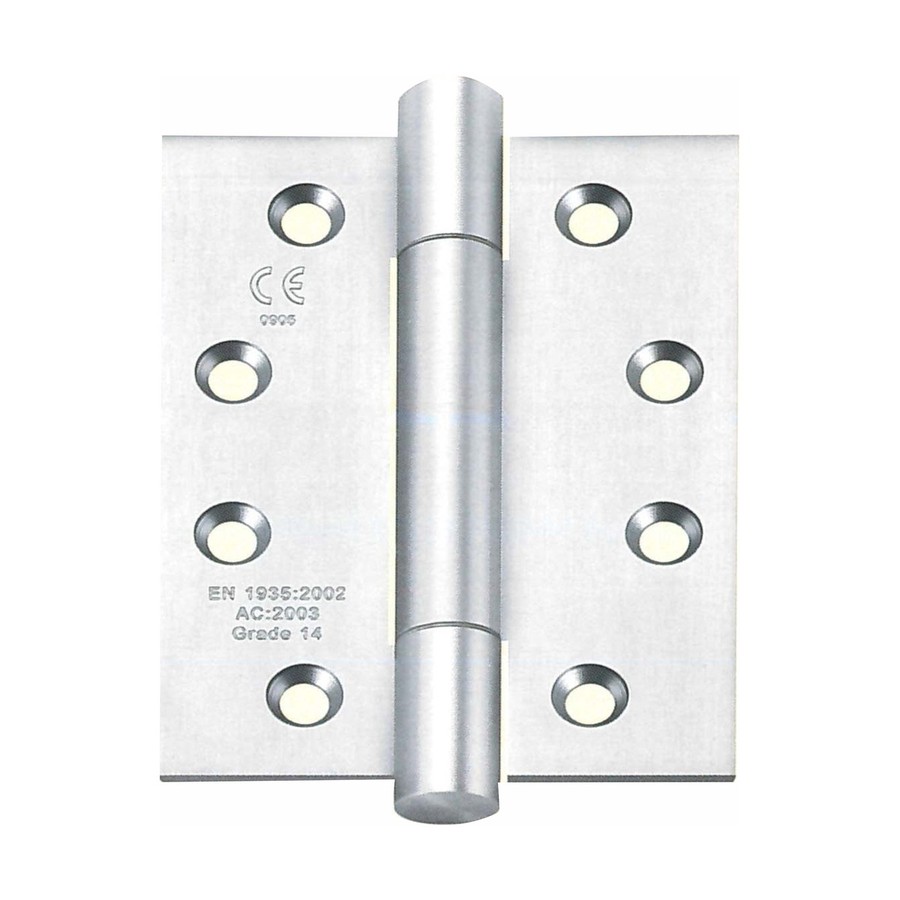
Four lines, stamped into the leaf rather than printed on a label:
| CE | The conformity mark itself |
|---|---|
| 0035 | The four-digit notified-body reference that sits under the mark |
| EN 1935:2002 | The European product standard for single-axis hinges, as amended by AC:2003 |
| Grade 14 | The classified grade the item was assessed to |
On a European project, the inspector reads the leaf, matches it to the door schedule, and checks the paperwork behind it. A hinge with no marking stops the sign-off however well it performs — which is why the mark is stamped through the plating line and not applied afterwards.
Under the European construction-products rules, the CE marking and the declaration of performance belong to the party that places the product on the market — the importer or the brand owner. When a European customer orders from us as an OEM supplier, that customer holds the assessment and instructs us to stamp the marking into the leaf. We manufacture to the drawing and the tolerances the assessment was made against, keep the batch records, and ship the hinge carrying their mark. The certificate is theirs. The production is ours.
That is the normal arrangement for a factory like ours, and it is worth saying plainly because the alternative is common in this trade: a supplier who photographs a marked hinge and implies the certificate is his own. A buyer who asks for the paperwork finds out at the worst possible moment. We would rather tell you on the page.
| If this is your situation | What we can do |
|---|---|
| You hold the CE assessment for the hinge you are buying | We manufacture to your specification, stamp the marking into the leaf as instructed, and hold the dimensional and material tolerances your assessment was made against. Send the drawing and the marking text. |
| You are importing into the EU and need a CE-marked product | The marking has to come from an assessment held by you or your EU partner. We can produce the hinge to that specification and quote the production side — we cannot sell you a certificate, and any factory that offers to is selling you a problem. |
| Your market does not require CE | Same hinge, same 160 kg rating, same washer stack, produced without the customer marking. This is what most of our volume is. |
The short version: we have produced this hinge for a European customer, to their CE-marked EN 1935 Grade 14 specification, and the photograph is the production part rather than a render. The certification is the customer’s; the manufacturing, the tolerance control and the batch records are ours. If you are buying for the EU, bring your specification and we will quote against it.
The hinge is the same hinge. What changes is whether damping grease is packed into the knuckle before it is closed — and that single decision is what a buyer feels in the door.
Damping grease is added inside the knuckle. It does two jobs: it lubricates the movement, and it damps it. The result is a leaf that settles into the frame instead of arriving there — smoother through the swing, softer at the last few degrees, and quieter on a door that gets closed rather than eased shut.
That cushioned feel is why the greased build is the one specified for hotel corridors, apartment entrance doors and anywhere the sound of a door closing is part of how a building is judged. Where a lighter, drier touch is wanted, the amount and the grade of grease can be adjusted — some oiled units are built clean enough to behave very close to an oil-free hinge, without giving up the cushioning entirely.
No damping grease is added. The hinge runs dry on its hardened washers, so there is nothing to migrate, nothing to weep onto a pale door, and nothing that dust and cleaning chemicals can turn into a grinding paste.
That is the build for doors that will be cleaned aggressively, for light-coloured leaves and frames where an oil stain under the knuckle is unacceptable, for food and clinical areas, and for any building where nobody will ever maintain two hundred hinges. It is also the safer choice in a hot climate, where grease softens and finds its way out of the knuckle over a long service life.
| What changes | Oiled — damping grease | Oil-free — no grease |
|---|---|---|
| Feel through the swing | Cushioned, damped, quieter at the close | Free and dry, no damping at the end of the arc |
| Risk of staining a pale leaf | Real over a long service life in heat | None — there is no oil to migrate |
| Cleaning and wash-down | Grease traps dust and cleaning residue | Hoses down and keeps working |
| Maintenance | Stays smooth longer if the building is maintained | Nothing to top up, ever |
| Best fit | Interior doors where the closing sound matters | Public, clinical, coastal and high-cycle doors |
How it is ordered: it is an option on the order, not a separate product — same model, same size, same MOQ. Oiled adds about USD 0.08 per hinge over the oil-free build. Write "oiled" or "oil-free" against each line of the purchase order, and tell us if you want the greased build made on the dry side.
One point worth stating plainly: neither build removes the need for the door to be hung correctly. Damping grease does not add load capacity, and a dry knuckle does not stop a leaf sagging if two hinges are doing the work of three. Choose the fill for how the door should feel and how the building will be run; choose the size and the count for the weight.
A 160 kg hinge is not the cheap option on a 35 mm interior door. It is the option that stops a callback on the doors where a standard hinge quietly gives up.
The door that gets kicked open forty times a day between classes. Cycle count, not door weight, is what kills the hinge here — and a maintenance team with two hundred doors will never lubricate any of them. Oil-free, 304, brushed finish, and the callback list gets shorter.
Two requirements at once: wash-down cleaning, which strips grease out of a knuckle, and a door that must not drift out of alignment on a ward corridor. A washer stack survives the cleaning regime; a greased pin does not.
Heavy fire-rated leaves with closers, hung on frames that have to look right. This is where the four finishes carry their weight as much as the load rating — gold SB for refurbishment matching, gun-metal for corridors, black for the black-framed partitions in the lobby.
A fire door leaf with a closer is the heaviest thing a standard hinge is ever asked to carry, and the one where sag has consequences. Three hinges on a tall leaf, a 160 kg pair on the load path. Worth saying clearly: fire performance belongs to the tested door assembly, not to a hinge on its own — the hinge's job is to keep the leaf in the frame so the assembly can do its job.
Salt air and plant-room dust both attack a greased knuckle from the inside. 304 with a washer stack has nothing inside to attack. Gun-metal hides the handling marks that come with a site install.
Existing frames, existing mortises, occupied building. Order by size and pattern, re-hang one leaf at a time, and match the finish to the ironmongery already on the door rather than replacing the furniture to suit a hinge.
A standard general-range hinge is rated 45 kg per pair. A solid-core timber door 2.1 m tall and 900 mm wide, with a closer bolted to it, is comfortably past that once the closer is pulling against the hinge line every time the door swings. The hinge does not fail dramatically — it develops play, the leaf drops two millimetres at the lock side, and the door starts catching. Someone goes back with a screwdriver and a chisel, and the next door does the same thing in six months. The 160 kg pair exists so that conversation does not happen, and the price difference between the two hinges is smaller than one site visit.
The honest limit: this is not a pivot for a steel door, and it is not a replacement for a floor spring on a frameless glass leaf. On a timber or steel-cased frame with a timber leaf it is the right hinge, and the six sizes cover 4″ to 5″ with 3″ to 4″ widths — enough for a standard door, not enough for a 2.4 m architectural leaf, which we would quote as a non-standard item instead.
A 160 kg pair becomes a 90 kg pair the moment it is screwed into a soft frame with the wrong screws. Six checks, in the order they matter.
Two hinges rated 160 kg per pair carry 160 kg — that is the pair figure, not each hinge. On a leaf above roughly 2.1 m, on a fire door, or on a glazed leaf with a closer, use three. Three hinges do not add up to 240 kg of rating; they share the load and stop the top hinge carrying the whole leaf on its own.
The 3.0 mm leaf needs a rebate that lets the plate sit flush, no deeper. If the frame was cut for a thinner general-range hinge, the mortise has to come out further — packing a 3.0 mm plate out with card is how a door ends up hanging on the screws instead of on the frame.
Timber frame, timber screws. Steel-cased frame, machine screws or a rivet nut, not a self-tapper that strips the casing on the last turn. The screws carry the whole load into the frame; the hinge only decides how smoothly the door swings.
Set the top leaf, hang the door on it alone with the bottom hinge loose, and check the gap at the lock side before the bottom screws go in. Adjusting the mortise after all six screws are tight means filling and re-cutting, which is where a Friday afternoon disappears.
Twenty full cycles tells you what a hundred will do: a bind at one point in the arc, a leaf that drifts, a knuckle that clicks. All three are installation faults at this stage, not hinge faults — and all three are cheaper to fix now than after the floor is finished.
On the oil-free build, adding oil is the one thing that will shorten its life: it collects dust into the washer stack and turns a dry bearing into a grinding paste. If a fitter reaches for the can out of habit, stop him. There is no maintenance interval on this hinge, and that is the point of it.
Before you order: measure the existing leaf thickness and weigh or estimate the leaf, count the hinges already on the door, and check whether the frame is timber or steel-cased. Those four answers pick the size, the pattern and the finish. Send them with a photo of the frame and we will come back with a model rather than a question.
The six models cover the doors most buildings have. The rest come off the same tooling with a different drawing — that is what the non-standard oil-free series exists for.
Custom on this range is usually one of four things, in descending order of how often we are asked:
Two things we will not customise: the material grade behind a 304 claim, and the grade marked on the leaf. A custom hinge is a different shape, not a different product.
Send a drawing or a sample hinge with the four measurements — leaf height, leaf width, thickness, hole centres — plus quantity, finish and destination. We come back with a tooling position and a unit price, and we do not start cutting until a sample has been approved against your drawing.
Tooling carries its own minimum, quoted per drawing rather than published here: a hole-pattern change and a new leaf size are not the same amount of work, and a number on a web page would be wrong for one of them.
The same workshop builds the flag hinge, H hinge, L hinge and spring hinge patterns — HY-H for the H pattern, spring and self-closing for auto-return doors, and custom hardware for anything drawn from scratch. If your door needs a pattern that is not on this page, it is probably already in the catalogue.
No damping grease is packed into the knuckle. The leaf turns on a stack of hardened washers instead, so there is nothing to dry out, nothing to migrate onto a pale door, and nothing for dust and cleaning chemicals to bind to.
Oiled means the same hinge with damping grease added inside the knuckle — it lubricates the movement and damps it, which is what gives the smoother, cushioned close. Same product, two fills; you pick one on the order.
About USD 0.08 per hinge more than the oil-free build. It is an option on the order — same model, same MOQ, same lead time — so you choose it per line on the purchase order rather than switching product.
Yes. The fill is an option across the general range too — 4, 5 and 6 inch, 2.5 / 3.0 / 4.0 mm leaf, 201 or 304 — using that range’s own parameters. If your frame is already cut for a general-range hinge and you only want the smoother, damped close, you keep the hinge and add the fill.
Per pair. Two hinges carry 160 kg between them, so a 120 kg leaf is inside the rating on a two-hinge hang. If you are comparing this with another supplier's figure, check which basis they quote — a per-hinge number always looks larger than a per-pair number for the same product.
Six models from 4″ to 5″ tall and 3″ to 4″ wide, all on a 3.0 mm leaf: HY-433, HY-4353 (two rows — 3.5″ and 4″ wide), HY-4543, HY-533 and HY-5353. Outside those, the non-standard series covers other leaf sizes and hole patterns to a drawing.
Match the frame you already have. Butterfly is the flat pattern with the aperture in the plate and the one most timber doors are cut for; butt is the square-edge pattern with the knuckle proud of the leaf line, usual on steel-cased frames and prepared linings. Both are rated the same, so the pattern is a fitting decision, not a performance one.
The hinge is stamped CE 0035, EN 1935:2002, AC:2003 and Grade 14 — you can see it in the photograph above. The marking is supplied by the customer on whose specification we produced it; it is not a certificate held in our name, and we will not describe it as one.
What we do is manufacture to that specification and stamp the leaf as instructed, which is why we can show a production hinge from an EU order rather than a stock photo. If you hold the assessment for the hinge you are buying, send the drawing and the marking text and we will quote the production. If you need the certificate itself, it has to come from the party placing the goods on the EU market.
201 for dry interior doors: offices, apartments, shop fit-outs. 304 where the door sees moisture, salt air, wash-down or cleaning chemicals — coastal buildings, hospitals, food areas, exterior-facing doors under a canopy. The price difference is real and 304 is not automatically the right answer for an inland office block.
35 mm and above, on wooden doors of any type. Below 35 mm the leaf cannot take the screw depth, and a hinge this heavy will pull out of a thin hollow-core door rather than carry it.
Two on a standard leaf. Add a third on doors above roughly 2.1 m, on fire doors, and on glazed leaves with a closer. The third hinge does not increase the rating — it stops one hinge carrying the whole leaf and is what keeps a tall door from dropping at the lock side.
The oil-free build, no. That is the reason to specify it. Do not add oil to it — on a dry washer stack, oil collects dust and turns a bearing into a grinding paste. Wipe the leaf when the door is cleaned and leave the knuckle alone. The oiled build is the opposite case: it holds its fill for the life of the hinge, and a building that services its doors gets a slightly longer smooth period out of it.
2,000 pcs for a trial order and 20,000 pcs for bulk pricing, counted per item — models, sizes and finishes can be mixed inside one order. Custom drawings carry their own tooling minimum, quoted per drawing.
30–35 days after deposit and sample approval. T/T 30 % deposit and 70 % against the B/L copy, with a 40 % deposit on your first three orders and 30 % from the fourth. Samples are free; you cover the freight.
Yes — brand, part number or project reference, in the position where the grade marking sits. It goes on the leaf in addition to the marking, never instead of it. Send the artwork with the order; it is cut into the same tooling, so it does not add a separate production step.
A photograph of the frame with a ruler against the existing plate, the leaf thickness and roughly what the door weighs is enough for us to come back with the right model, pattern and finish — usually the same day. If you already know what you want, quote the code and the leaf size and we will price it directly.
The same commercial terms apply across our hinges. Full detail, including the sample and inspection steps, is on how ordering works.
2,000 pcs trial, 20,000 pcs bulk. Counted per item — models, sizes and finishes can be mixed in one order.
T/T 30 % deposit and 70 % against the B/L copy. 40 % deposit for your first three orders, 30 % from the fourth.
Free of charge; you pay the freight. Send your courier account or we quote it.
30–35 days after the deposit and sample approval.
EXW, FOB and FCA — FOB Nansha Port, Guangzhou.
White box, two hinges, each in its own bag. The box prints to your artwork and part numbers.
Raw material bought in one lot per order, colour checked in process, out-of-tolerance units scrapped rather than shipped.
Load plan, carton count and gross weight are calculated per order — palletised or loose, depending on the destination.
Carton counts and weights are not fixed figures. Some destinations take cartons loose and carry more pieces in the same container; others require heat-treated timber under ISPM 15, and some customers want no timber at all. Send the model, size, finish, quantity and destination port, and your account manager will work the load plan out for that case before you commit.