Home / Buying guides / Hinge troubleshooting
A door that will not sit flush, sags at the top corner, or stops closing quietly is rarely a broken hinge. In most cases it is a wrong mounting plate, a cup bored in the wrong place, too few hinges, or an environment the damper was never specified for.
14 min read · By Alwin Pan, Overseas Business Director, Haoyue Metal
We get these photographs from installers and distributors every week: a steel rule held against an uneven gap, a close-up of a stripped screw hole, a soft-close door that stops two inches short. Most of them can be diagnosed before a replacement hinge is ordered. This guide is the order of checks we walk through, and the fixes that actually hold under a door's repeated load.
Adjusting first is the most common mistake. A door that will not close usually needs a depth adjustment, but no amount of adjustment fixes a wrong plate. Work down this list.
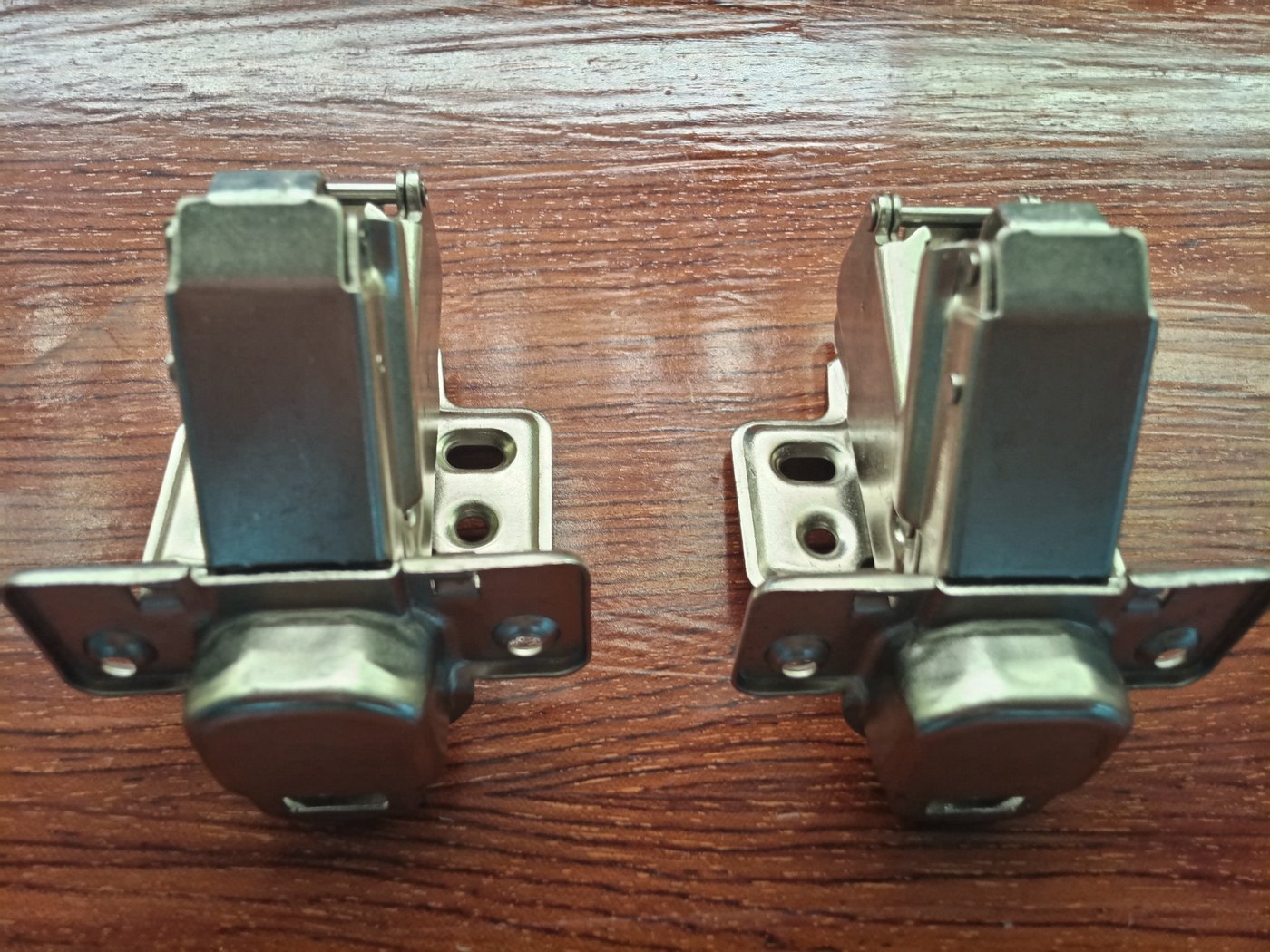
| Symptom | Most likely cause | Fix |
|---|---|---|
| Door will not sit flush | Wrong mounting plate for the overlay type; or the carcass is out of square | Fit the correct plate first. Then use the depth cam. Do not force the door closed. |
| Uneven gap along the door | Cabinet not square, or a warped door | Shim or square the carcass. Hinge adjustment cannot correct a twisted box. |
| Top corner sags after a year | Too few hinges for the door height or weight; stripped fixings | Add a hinge to the count below; re-fix the plate in fresh holes. |
| Soft-close stops short | Light door does not engage the damper, or cup bored too close to the edge | Switch off the damper on one hinge if the model allows; verify K distance against the drawing. |
| Door slams in cold weather | Hydraulic oil thickens as temperature falls; the damper responds slowly | State the operating temperature range when ordering. Do not slam the door to force it. |
| Screws will not tighten | Stripped holes in particleboard or MDF; over-tightening at installation | Move the plate about 10 mm and drill fresh pilot holes. See the section below. |
| Door face split near the cup | Cup bored too close to the door edge (K too small) | Replace the door. Set K to 3–6 mm and use the model's drilling template. |
One detail worth repeating: the cup position is measured to the edge of the 35 mm bore, not its centre. With a 35 mm cup the radius is 17.5 mm, so a K of 5 mm puts the bore centre 22.5 mm from the door edge — the figure many shops treat as standard[3]. Moving that centre inwards by a couple of millimetres is enough to break out the door face on particleboard.
When a tall or wide door sags, the first question is not which hinge failed but whether enough were fitted. These counts are a working rule for domestic and light commercial doors; a heavier leaf or a door opened hundreds of times a day needs more[1].
| Door height | Hinges | Why |
|---|---|---|
| Up to 900 mm | 2 | Standard base and wall cabinet doors |
| 900 – 1600 mm | 3 | Pantry and tall larder doors |
| 1600 – 2000 mm | 4 | Full-height doors; the third and fourth control twist |
| Above 2000 mm | 5 | Floor-to-ceiling doors, or heavy applied panels |
| Any door over 600 mm wide | +1 | Off-centre load makes the top corner drop regardless of height |
If a door arrived with two hinges and now sags, adding a third or fourth in line with the existing ones usually recovers it — provided the screw holes still hold. If they do not, fix the holes first or the new hinge will pull out too.
A cabinet hinge is not a static fastener: it carries a swinging door, thousands of times, on a material with modest screw-holding strength. The temporary repairs you will find in woodworking guides — glued toothpicks, a whittled plug, filler — are fine for a light fitting, but rarely hold a door hinge under repeated load[5].
Move the mounting plate roughly 10 mm along the cabinet side and drill fresh pilot holes. Where a plate position cannot move, use a proper knock-down insert or a through fixing with a backing plate. On a heavy door, a solid wood lipping behind the hinge gives the screw something to bite[1][4].
Use screws intended for particleboard or MDF (twin-thread types hold better), drill a pilot hole to the full screw depth, and never over-tighten or hammer them. Screw-holding power depends on board density and screw type — get both from the panel supplier[4].
For a production run, this is a process issue rather than a repair: specify the screw, the pilot diameter and a torque limit in the assembly instruction. It is cheaper than a site visit.
A soft-close damper is a small hydraulic cylinder. Oil viscosity rises as temperature falls, so at low temperature the closing stroke slows and a door may stop short of the cabinet — or, if a light door never engages the damper in the first place, close with a bang. Both complaints arrive from unheated garages, holiday cabins and northern European or North American winter sites.
Do not slam the door to "free" the damper. Forcing it is the quickest way to damage the seal. Let the room warm up and re-test before condemning the hinge.
Separate cause from symptom: a small, light door may simply be too light to engage the damper. Where the hinge has an on/off switch, deactivating one hinge is often enough. If the hinge is correctly specified and the problem is the cold, tell us the operating temperature range at enquiry stage and we will confirm what we can supply.
This is a specification conversation, not a defect claim. A damper selected for a heated kitchen is not automatically a damper for a cold store, and the difference should be settled before the order rather than after installation. Our soft-close guide explains what the damper does and how its life is measured.
A crate hinge is a fatigue part. A reusable pallet collar is folded, stacked, forked and unfolded repeatedly, so the load is cyclic from the first day — unlike a cabinet hinge that swings in one plane.
| Cause | What you see | What to specify |
|---|---|---|
| Fatigue at the fixing holes | Elongated rivet holes, cracks radiating from a screw | Heavier gauge, correct rivet length for the panel build-up, and offset hole positions that avoid splitting plywood[6] |
| Wrong length for the box | Hinge bends, lid will not sit square | Match hinge length to collar height; a taller box puts more leverage on the leaf |
| Coating worn through | Rust at the fold line after sea freight | Zinc plating or a finish matched to the environment, with the salt spray hours stated |
| Wrong fastener | Rivet spins or pulls through the panel | Semi-hollow rivet or screw sized to the actual ply thickness, confirmed on a sample crate |
When you enquire, tell us how many trips the crate is expected to survive and how the panels are built up — those two numbers decide the gauge more than the hinge length does. See our pallet box hinge range for the sizes and finishes we hold.
Five signs mean the part itself has failed. Everything above this list is installation, specification or environment.
Oil visible on the arm, or a hinge that offers no resistance at all through the closing stroke. A leaking seal will not recover.
Broken, displaced, or a door that drifts open instead of staying where it is placed.
A crack in the cup, a bent arm, or a mounting plate distorted by over-tightening.
Plating eaten through and rust at the pivot — common in coastal or wash-down sites where 201 was used instead of 304. See the grade guide.
If several hinges on the same batch fail the same way, it is a batch issue rather than an installation one — send the carton marking and we can trace the production lot. That is the same evidence our testing guide asks buyers to put in a contract.
Usually the mounting plate is wrong for the overlay, not the adjustment. Check the plate first. If the plate is right and the gap still varies along the door, the carcass is out of square.
Filling with glue and toothpicks rarely holds under a door's repeated load. Move the plate about 10 mm and drill fresh pilot holes, or use a proper insert or through fixing. Use particleboard screws and do not over-tighten.
Three likely causes: a light door that does not engage the damper, a cup bored too close to the door edge, or a door heavier than the hinge was specified for. If the hinge has a damper switch, turning one off on a light door often fixes it.
It can. Hydraulic oil thickens as temperature falls, so closing slows and a door may stop short in an unheated space. Do not slam it. Tell your supplier the operating temperature range at enquiry stage.
Two up to about 900 mm, three to 1600 mm, four to 2000 mm, five above that — plus one extra on any door wider than about 600 mm. Match the count to weight and daily use, not height alone.
Too few hinges for the door height or weight, or a wide door with an off-centre load. Stripped fixings produce the same symptom. Check the count, then the holes, then the hinge.
Only within limits. K is normally 3–6 mm from the edge of the bore, giving a bore centre of roughly 20.5–23.5 mm from the door edge. Closer risks splitting the face; farther can make the door strike the cabinet side past 90°.
Fatigue around the fixing holes, too thin a gauge for the box height, worn coating, or the wrong rivet length. Reusable crates are cyclic-load parts — specify the number of trips and the panel build-up, not just the hinge length.
Oil leaking from the damper, a broken spring, a cracked cup or arm, a loose pin, or corrosion through the plating. Those are material failures; everything else is installation, specification or environment.
We have drawn on published cabinet-making and panel references for the geometry, hinge counts and screw-holding guidance. The diagnosis sequence and the crate section are our own workshop practice. Linked for reference; we do not reproduce their text.